afarhat - Page 2 of 20

Author: afarhat

Governor of the Central Bank of Libya Meets with the U.S. Assistant Secretary of the Treasury for the Middle East and Africa

Mr. Naji Mohammed Issa, Governor of the Central Bank of Libya, and the accompanying delegation met on Thursday, April 16, 2026, in Washington, D.C., with Mr. Eric Meyer, U.S. Assistant Secretary of the Treasury for the Middle East and Africa, in the presence of his senior officials.

The meeting focused on a number of issues of mutual interest, most notably:

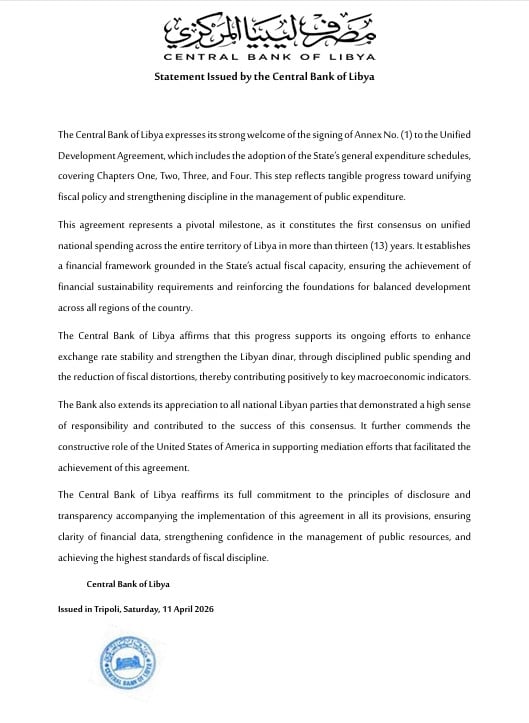
Reviewing the latest developments related to Libya’s financial and economic situation, particularly the agreement on establishing a framework for unifying public expenditure.
Following up on the initiatives launched by the Central Bank of Libya to implement economic reforms.
Enhancing mechanisms for executing external transactions with the U.S. Federal Reserve, and addressing corruption and the smuggling of foreign currency outside Libya—especially through letters of credit and the parallel market—and the associated risks of money laundering and terrorist financing.
Reviewing the Central Bank’s plan, as well as the necessary procedures and controls, to commence the regular distribution of U.S. dollar cash through commercial banks and exchange companies, in a manner that limits misuse for unlawful purposes, with the support of the U.S. Treasury for these efforts.

For his part, Mr. Eric Meyer commended the pivotal role played by the Central Bank of Libya despite significant internal and external challenges, praising its recent efforts in maintaining financial and monetary stability, preserving the Bank’s independence, and safeguarding the Libyan currency.

The U.S. Assistant Secretary of the Treasury also emphasized the importance of continued cooperation between the Central Bank of Libya, the U.S. Federal Reserve, and the U.S. Department of the Treasury in combating financial corruption, enforcing compliance standards and requirements, and taking decisive actions against those who violate such standards.

Washington praises the “historic achievement” of the Central Bank of Libya and affirms its full support for its independence

At the official invitation of the U.S. Department of State, H.E. Mr. Naji Mohammed Issa, Governor of the Central Bank of Libya, held a high-level meeting on Wednesday, April 15, 2026, at the Department’s headquarters in Washington, D.C., with Mr. Kyle Liston, Assistant Secretary of State of the United States.

During the meeting, the Governor reviewed the exceptional results achieved by the Central Bank through an ambitious package of economic reforms, which have significantly contributed to monetary and financial stability despite major regional and domestic challenges.

The discussions also highlighted the Central Bank’s qualitative achievements in strengthening compliance frameworks, enhancing anti-money laundering and counter-terrorism financing systems, and developing electronic payment infrastructure, as well as introducing non-traditional monetary policy instruments in line with international standards. These efforts have strengthened the confidence of international financial institutions in the Central Bank.

At the conclusion of the meeting, Mr. Kyle Liston praised the outcomes of the efforts led by the Governor and the Board of Directors of the Central Bank, emphasising the importance of fully supporting the independence of the Central Bank of Libya, considering it a fundamental pillar for Libya’s stability and the economic security of the region.

Governor of the Central Bank of Libya discusses with Visa Inc. enhancing financial inclusion and developing electronic payment services

H.E. Mr. Naji Mohammed Issa, Governor of the Central Bank of Libya, and his accompanying delegation, met on Wednesday , April 15, 2026, with Mr. Robert B. Thomson, Senior Vice President of Visa Inc. and Global Head of Government Engagement, in the presence of Ms. Caitlin M. McDonnell, Managing Director and Head of U.S. Government Relations at the company.

The meeting forms part of a series of engagements led by the Governor to advance financial inclusion in Libya, by promoting the expansion of electronic payment services and supporting the Central Bank’s efforts to enhance the oversight and regulation of financial transactions in accordance with international standards on anti-money laundering and combating the financing of terrorism.

Governor of the Central Bank of Libya discusses, during the MENAP Meeting, avenues for regional cooperation to address global economic challenges

Mr. Naji Mohammed Issa, Governor of the Central Bank of Libya, participated on Wednesday, April 15, 2026, in the meeting of Finance Ministers and Central Bank Governors of the Middle East, North Africa, and Pakistan (MENAP) group, which was held with Kristalina Georgieva, Managing Director of the International Monetary Fund, and her accompanying team, on the sidelines of the 2026 Spring Meetings of the International Monetary Fund and the World Bank in Washington, D.C.

The meeting discussed a broad range of economic and development issues of mutual interest, foremost among them the slowdown in global growth, inflationary pressures, and challenges related to commodity and energy prices. Participants also reviewed the importance of central bank independence and explored ways to enhance regional and international cooperation to develop resilient fiscal and monetary policies capable of withstanding current geopolitical and economic disruptions.

The discussions further addressed mechanisms for financing sustainable development and the role of the private sector in economic recovery, in addition to challenges related to rising debt levels and the increasing cost of external borrowing. The meeting’s closing statement emphasized the need to coordinate positions among member countries within the forums of the International Monetary Fund and the World Bank to ensure that each country’s development priorities are taken into account, while strengthening regional financial safety nets.

It is worth noting that the Spring Meetings bring together senior economic officials from 190 member countries and are being held this year amid expectations of challenging global economic conditions, placing MENAP countries before critical tests to balance inflation control with growth stimulation.

Governor of the Central Bank of Libya discusses with officials from JPMorgan Chase developments in the global economy and their implications for financial markets

As part of the Central Bank of Libya’s commitment to strengthening its network of relationships with leading correspondent banks worldwide, H.E. Mr. Naji Mohammed Issa, Governor of the Central Bank of Libya, and his accompanying delegation, met on Wednesday , April 15, 2026, with Mr. Max Neukirchen (Managing Director, Head of Payments, and Global Co-Head of Payments at JPMorgan Chase), along with Ms. Masha Glukhova (Head of Public Sector), and Mr. George El Ashkar (Head of Public Sector for the Middle East and North Africa), at the bank’s headquarters in Washington.

During the meeting, a number of topics of mutual interest were discussed, most notably international economic developments and geopolitical developments in the Middle East region. This comes within the framework of ongoing coordination to enhance financial stability, diversify sources of foreign exchange reserve returns, and keep pace with global best practices in managing and developing these reserves in line with cooperation agreements with international institutions.

Governor of the Central Bank of Libya discusses with the International Monetary Fund strengthening the legal frameworks for financial governance and combating financial crimes

H.E. Mr. Naji Mohammed Issa, Governor of the Central Bank of Libya, and his accompanying delegation, held a meeting on Tuesday ,April 14, 2029, in Washington, D.C., with Mr. Brian Patterson, Deputy General Counsel for Legal Affairs at the International Monetary Fund, in the presence of representatives from the Fund’s Legal Department.

The meeting was dedicated to exploring ways to enhance technical and legal cooperation between the Central Bank and the Fund. the discussions focused on the legislative and legal frameworks that the Central Bank intends to introduce, most notably:

– A draft law on Anti-Money Laundering and Combating the Financing of Terrorism, in line with the highest international standards issued by the Financial Action Task Force (FATF).
– The update of Banking Law No. (1) of 2005, as amended by Law No. (46) of 2012, to align with modern governance and banking supervision requirements.
– The update of the licensing regulation for electronic payment companies, in line with digital transformation and aimed at enhancing financial inclusion while adhering to cybersecurity standards.

At the conclusion of the meeting, it was agreed that the International Monetary Fund will provide specialized technical support to the technical and legal teams formed by the Central Bank of Libya, with the objective of preparing initial drafts of these laws and regulations. This cooperation is expected to contribute to strengthening the safety and stability of the Libyan financial system.

Governor of the Central Bank of Libya holds an extensive meeting with K2 Integrity to strengthen banking compliance and review documentary credits

On the sidelines of the Annual Meetings of the International Monetary Fund and the World Bank, currently held in Washington, D.C., Mr. Naji Mohamed Issa, Governor of the Central Bank of Libya, along with the accompanying technical and banking delegation, held an extensive meeting on Tuesday , April 14, 2026, with officials from K2 Integrity, a firm specialized in financial advisory and risk assessment.

The meeting came as part of the Central Bank’s proactive approach to strengthening governance within the Libyan banking sector. Discussions focused on the strict measures and controls recently introduced by the Central Bank of Libya, aimed at conducting a comprehensive review of all applications for documentary credit coverage in accordance with rigorous assessment mechanisms, enhancing banking supervision practices, and reinforcing the role of compliance departments and units within commercial banks, in a manner that safeguards the Libyan banking sector and ensures its adherence to international standards.

Governor of the Central Bank of Libya discusses with the Deputy Managing Director of the International Monetary Fund the implementation of the economic reform agenda

On Monday, April 13, 2026 In a move reflecting the accelerating pace of economic reform in Libya, H.E. Mr. Naji Mohammed Issa, Governor of the Central Bank of Libya, and his accompanying delegation held an expanded meeting this evening with Kenji Okamura, Deputy Managing Director of the International Monetary Fund, in the presence of senior IMF officials, to discuss mechanisms for implementing an integrated vision aimed at addressing Libya’s long-standing structural economic imbalances.

The two sides reviewed the outcomes of the Article IV consultations. The IMF commended the efforts of Libyan institutions in enhancing transparency and the disclosure of data and information, considering it a qualitative shift in the management of economic affairs.

The Governor presented his reform vision to overcome the crisis, which is based on a comprehensive package of fundamental reforms, most notably: unifying public expenditure, and conducting a full review of monetary, trade, and fiscal policies, in a proactive approach aimed at addressing structural distortions that have hindered recovery for decades, as well as continuing the implementation of the Central Bank’s strategy to promote financial inclusion and digitalization of the economy, which now covers around 90% of economic activity and financial transactions.

The IMF welcomed this vision, going beyond praise to explicitly express its readiness to provide intensive technical assistance and advanced advisory support, particularly in the areas of exchange rate policy and restoring the strength of the Libyan dinar, sending a clear international message of support for the reforms led by the Central Bank.

Governor of the Central Bank of Libya meets with the Director of the Middle East and Central Asia Department at the International Monetary Fund

H.E. Mr. Naji Mohammed Issa, Governor of the Central Bank of Libya, and his accompanying delegation held a meeting with Jihad Azour, Director of the Middle East and Central Asia Department at the International Monetary Fund, his team, as well as the Head of the IMF mission to Libya and her accompanying team.

The meeting aimed to discuss economic developments in Libya and the region, and to review the outcomes of the Article IV consultations recently held in Tunis over the past few days.

The discussions addressed recent positive fiscal developments, particularly in light of tighter control and rationalization of public spending, as well as the improvement in oil revenues driven by rising global prices. These developments are expected to have a direct and positive impact on supporting and stabilizing the official exchange rate.

Governor of the Central Bank of Libya discusses with the International Monetary Fund strengthening cooperation in the areas of financial stability and banking supervision

Washington, April 13, 2026 In a move reflecting the confidence of international financial institutions in the strength of the Libyan banking system, H.E. Mr. Naji Mohammed Issa, Governor of the Central Bank of Libya, and his accompanying delegation held a meeting with Atilla Csajbok, Head of the Monetary and Capital Markets Department at the International Monetary Fund, along with a high-level team, on the sidelines of the 2026 Spring Meetings in Washington, D.C.

The meeting served as a qualitative dialogue platform focused on strengthening Libya’s partnership with the IMF in several critical areas, including technical assistance for capacity building in reserve management and foreign exchange operations, methodologies for assessing the exchange rate of the local currency against the Special Drawing Rights (SDR) basket, development of banking supervision, and advancing financial stability through the implementation of rigorous stress testing frameworks, in addition to full compliance with anti-money laundering and counter-terrorism financing standards.

The discussions also reviewed future aspirations for technical assistance in governance and internal audit functions. Ms. Csajbok and the IMF team highly commended the notable efforts undertaken by the Central Bank of Libya, particularly praising its progress toward institutional independence through the implementation of the “Central Bank Transparency Code (CBT-Code),” a milestone achievement considered a significant leap forward and a model to be followed.

At the conclusion of the meeting, both sides emphasized the importance of continuing and strengthening this technical support in the coming period, in line with a shared vision for a more transparent, efficient, and stable Libyan financial system.

Governor of the Central Bank of Libya begins his meetings in Washington with a meeting with the Statistics Department at the International Monetary Fund(IMF)

H.E. Mr. Naji Mohammed Issa, Governor of the Central Bank of Libya, along with his accompanying delegation, commenced on Monday , April 13, 2026, his official meetings in Washington, D.C., which began with a key meeting with Alberto Kruse, Director of the Statistics Department at the International Monetary Fund, his Deputy Andrea Lemgruber, and their accompanying technical team.

The meeting featured advanced discussions focused on the necessity of achieving a qualitative leap in updating economic data and enhancing its quality to accurately reflect the true state of the Libyan economy. The discussions emphasized the development of the Consumer Price Index (CPI), the precise calculation of inflation rates, and the preparation of Gross Domestic Product (GDP) data at both current and constant prices.

The meeting resulted in two key agreements, reflecting the confidence of international institutions in the seriousness of Libya’s reform efforts:

  • Exceptional technical support for the Central Bank of Libya, aimed at facilitating a smooth transition to the seventh edition of the Balance of Payments Manual, in line with the highest international standards.
  • Comprehensive support for the State of Libya, coordinated through the Ministry of Planning, to develop the macroeconomic data system and strengthen its capacity for evidence-based decision-making.

This meeting comes as part of a series of engagements through which the Governor seeks to correct and restructure the statistical foundations in Libya.