
Author: afarhat

Governor of the Central Bank of Libya Meets with General Managers of Commercial Banks to Review Cash Distribution Plans and Enhance Electronic Payment Services
H.E. Naji Mohammed Issa, Governor of Central Bank of Libya, held a meeting with the general managers of commercial banks, in the presence of the heads of relevant departments at the Central Bank. The meeting focused on assessing the availability of cash, reviewing distribution plans for the coming week and the period ahead, and discussing developments in electronic payment indicators on Wednesday, 10 December 2025.
The Governor emphasized during the meeting that the distribution of 4 billion Libyan dinars in cash to commercial banks would commence this week for onward distribution to their branches. He noted that cash will be available across all bank branches starting next week to meet citizens’ needs without delay, with extended working hours, and underscored the importance of ensuring that ATMs remain fully replenished around the clock.
He further stressed to the general managers the need for strict discipline in distribution and disbursement operations within the branches, and the adoption of clear mechanisms that guarantee fair and consistent access to cash across all regions. He affirmed that this matter will remain under his direct supervision and follow-up.
The Governor also instructed banks to enhance the use of electronic payment channels and expand their services to support the desired digital transformation through continuous improvement of the underlying infrastructure. This, he noted, would help alleviate pressure on cash withdrawals and improve the overall quality of banking services provided to citizens.
The attendees affirmed their commitment to implementing the issued directives and to working towards improving banking performance in a manner that ensures the stability of services and meets the needs of the public.

Announcement:
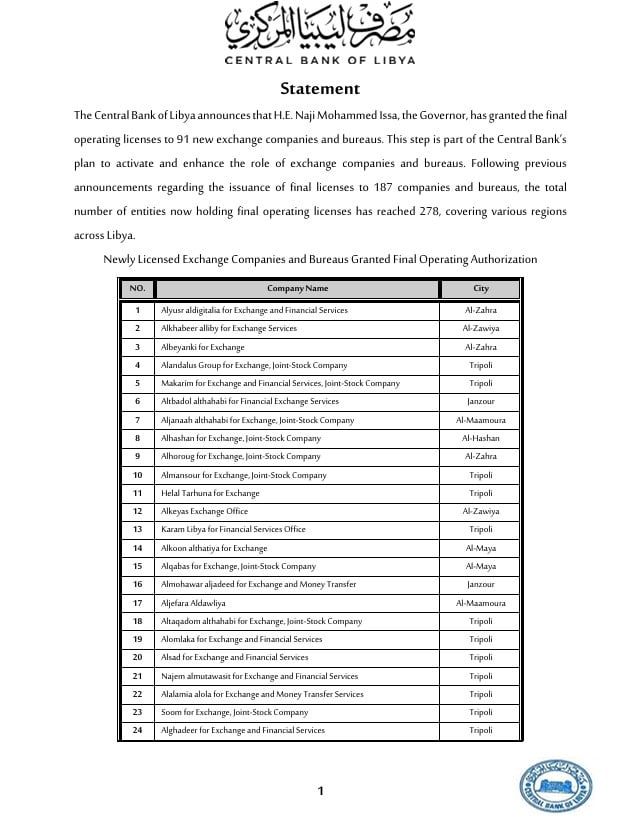
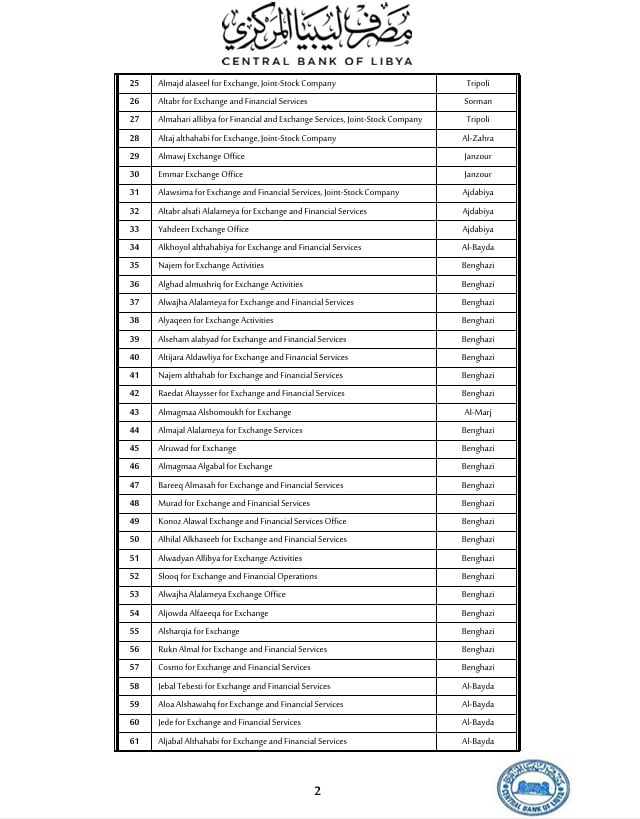
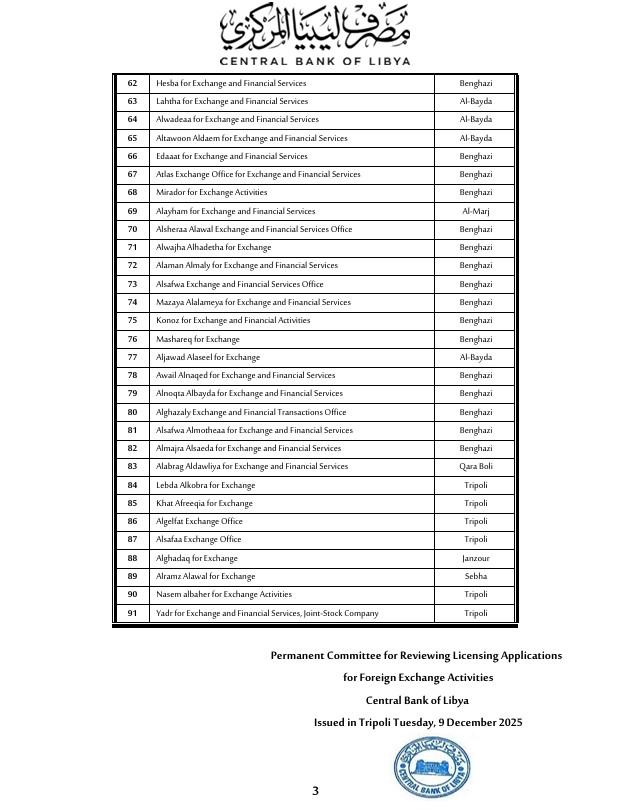
The Central Bank of Libya announces that H.E. Naji Mohammed Issa, the Governor, has granted the final operating licenses to 91 new exchange companies and bureaus. This step is part of the Central Bank’s plan to activate and enhance the role of exchange companies and bureaus. Following previous announcements regarding the issuance of final licenses to 187 companies and bureaus, the total number of entities now holding final operating licenses has reached 278, covering various regions across Libya.

Central Bank of Libya Announces the Receipt of November Salaries and the Start of Their Execution Through the “Ratebk Lahthi” Project
The Central Bank of Libya announces that it has received the November salaries from the Ministry of Finance and has forwarded them to commercial banks for execution within the framework of the “Ratebk Lahthi” project, which enables citizens to track the disbursement of their salaries instantly and transparently.
The Central Bank affirms that the “Ratebk Lahthi” project is part of ongoing efforts to advance digital transformation, enhance transparency in the public financial management system, and ensure that salaries reach their beneficiaries in a timely manner without delay.
Citizens can follow the status of their salary execution by accessing the Citizens’ Platform via the following link:
🔗 fcms.cbl.gov.ly
They may also review statistics related to commercial banks’ execution of salary payments through the following link:
🔗 cbl.gov.ly/salary
The Central Bank of Libya reiterates its commitment to developing digital banking services and improving the efficiency of payment procedures in line with the requirements of electronic transformation within the financial sector.

The Governor of the Central Bank of Libya Meets with the President of the Presidential Council
H.E. Naji Mohammed Issa, Governor of the Central Bank of Libya, met with the President of Presidential Council, Dr. Mohamed Al-Menfi, at the Council’s headquarters in Tripoli on Wednesday afternoon, 26 November 2025.
The meeting reviewed the latest economic developments and the reform measures being implemented by the Central Bank.
The Governor emphasized that the current plan focuses on enhancing the effectiveness of the banking sector by strengthening governance and transparency, improving financial disclosure mechanisms to reinforce institutional discipline and support monetary stability. He affirmed the Bank’s continued commitment to providing additional liquidity to commercial banks in the coming period, in order to support market stability and enhance the banking system’s ability to meet the needs of citizens and economic actors., Governor of the Central Bank of Libya, met on Wednesday afternoon, 26 November 2025, with the President of the Presidential Council, Dr. Mohamed Al-Menfi, at the Council’s headquarters in Tripoli.
The meeting reviewed the latest economic developments and the reform measures being implemented by the Central Bank.
The Governor emphasized that the current plan focuses on enhancing the effectiveness of the banking sector by strengthening governance and transparency, improving financial disclosure mechanisms to reinforce institutional discipline and support monetary stability. He affirmed the Bank’s continued commitment to providing additional liquidity to commercial banks in the coming period, in order to support market stability and enhance the banking system’s ability to meet the needs of citizens and economic actors.

Governor participates in an extensive meeting to review issues related to the oil sector attended by the President of the Audit Bureau the Attorney General and the Chairman of the National Oil Corporation
The Governor of the Central Bank of Libya, H.E. Naji Mohammed Issa, convened on Tuesday morning, 25 November 2025, at the Audit Bureau’s headquarters, for an extensive that brought together the President of the Audit Bureau, Mr. Khaled Shakshak; the Attorney General, Counselor Al-Siddiq Al-Sour; and the Chairman of the National Oil Corporation, Mr. Masoud Suleiman, with the participation of several specialized departments from the concerned institutions.
The meeting addressed a number of key issues related to the oil sector, including discussions on the fuel supply file and oil revenues, as well as the measures taken by the National Oil Corporation regarding the announcement of the public tender and the commitment to transparency and fair competition in fuel procurement for the year 2026.
Participants also discussed challenges related to the collection of oil revenues and the mechanisms for settling fuel payments, in addition to reviewing the sector’s budget, the proxy-payment mechanism, and its implications for the state’s general budget.
The meeting further examined the reasons behind the decline in oil revenues during the recent period, the financial and operational challenges facing the National Oil Corporation, and ways to overcome bottlenecks to ensure improved financial performance and strengthen transparency.
In the same context, the proposed measures to address fuel smuggling were reviewed, along with the need to enhance institutional coordination to ensure stricter control over this strategic resource.
At the conclusion of the meeting, participants emphasized the need for full compliance with public tender procedures related to fuel procurement and the sale of crude oil in accordance with approved legal and technical standards. They also stressed the importance of reviewing agreements and ensuring their sound implementation to guarantee the highest levels of transparency and fair competition.
The attendees further underscored the importance of addressing existing observations and strengthening coordination and communication among the relevant entities to ensure the stability of oil- and fuel-related operations in the coming period.

Governor of the Central Bank of Libya Meets with the President of the Libyan Audit Bureau
The Governor of the Central Bank of Libya, H.E. Naji Mohammed Issa, held a meeting, with the President of the Audit Bureau, Mr. Khaled Shakshak, to discuss the procedures for approving the budgets of the Central Bank and Libyan commercial banks, as well as to review a number of oversight and financial files related to enhancing the performance of the banking sector in a manner that ensures greater transparency and improves the level of financial disclosure on Wednesday, 19 November 2025.
The discussions also covered the review of public spending controls, the continued rise in public expenditure and its impact on the Central Bank of Libya’s ability to maintain exchange rate stability, in addition to the importance of establishing a unified general framework for public spending that supports financial sustainability and monetary stability.
The meeting further addressed the measures taken by the Central Bank as part of its financial inclusion strategy, digital transformation efforts, expansion of electronic payment services, development of currency exchange activities, and reduction of the parallel market.
Both parties agreed to maintain ongoing joint coordination to ensure compliance with regulatory standards and to strengthen financial discipline across all banking institutions.

Central Bank of Libya commends the Unified Development Agreement and considers it a cornerstone for strengthening economic and financial stability
The Central Bank of Libya welcomes the signing of the agreement on the Unified Development Program between the House of Representatives and the High Council of State, considering it an important national step toward strengthening financial stability and unifying development efforts across all regions of Libya.
The Central Bank of Libya affirms its full support for this agreement, which reflects a shared sense of responsibility, reinforces the principles of transparency and good governance, and establishes a clear framework for unifying spending channels and financing development projects. It also positively impacts the economy by directing resources toward productive investment in sectors such as infrastructure, education, and health, thereby promoting economic growth and improving social conditions. Furthermore, it contributes to achieving economic stability, ensuring fair distribution of resources, and realizing sustainable development.
This measure represents a proactive and necessary step to safeguard the macroeconomy from greater challenges previously warned of by the Central Bank’s Board of Directors.
The Central Bank of Libya also values the provisions included in this agreement and affirms its full readiness to carry out the tasks assigned to it in accordance with applicable legislation.
The Central Bank reiterates its commitment to working with all national parties in a spirit of cooperation and coordination to ensure the success of this agreement and the achievement of its objectives in service of the nation and its citizens.

Governor of the Central Bank of Libya meets with the Assistant Secretary-General and Regional Director for Arab States at the United Nations Development Programme (UNDP)
H.E. Naji Mohammed Issa, Governor of Central Bank of Libya, met with Dr. Abdullah Al-Dardari, Assistant Secretary-General and Regional Director for Arab States at the United Nations Development Programme (UNDP), in the presence of Ms. Sophie Kemkhadze, the UNDP Resident Representative in Libya on Tuesday, November 4, 2025.
The meeting reviewed the UNDP’s strategic projects in Libya and discussed avenues of cooperation in developing the public sector, public finance, combating corruption and money laundering, as well as enhancing institutional development, capacity building, and accelerating digital transformation by leveraging artificial intelligence technologies in line with the objectives of the National Financial Inclusion Strategy adopted by the Central Bank of Libya.
Both sides also discussed supporting small and medium-sized enterprises, promoting financial inclusion and digitization, and strengthening capabilities in financial and economic modeling and analysis.
The two parties agreed to proceed toward signing a Memorandum of Understanding between the Central Bank of Libya and the United Nations Development Programme (UNDP) following the completion of technical studies and a review of relevant international experiences.

Governor of the Central Bank of Libya meets with the Special Representative of the Secretary-General of the United Nations
Following the inauguration of the Banking Investment Conference, H.E. Naji Mohammed Issa, Governor of Central Bank of Libya, met today with Ms. Hanna Tetteh, the Special Representative of the Secretary-General of the United Nations, to discuss the current political and economic situation and review the prevailing challenges on Tuesday, November 4, 2025.
After reviewing the latest developments, Ms. Tetteh commended the Central Bank of Libya’s efforts in maintaining monetary stability despite the ongoing political and institutional division, as well as its initiatives to launch a package of economic reforms aimed at achieving economic stability.

Governor of the Central Bank of Libya inaugurates the Banking Investment Conference and its Role in Promoting Economic Development
Governor of the Central Bank of Libya, H.E. Naji Mohammed Issa, inaugurated on Tuesday, November 4, 2025, in Tripoli, the Banking Investment Conference and its Role in Promoting Economic Development, in the presence of Mr. Abdulhamid Dbeibah, Prime Minister of the Government of National Unity, Dr. Mohamed Takala, President of the High Council of State, a number of members and representatives of the Libyan House of Representatives, several members of the Board of Directors of the Central Bank of Libya, as well as a number of ministers from the Government of National Unity, directors of departments at the Central Bank, representatives of major international companies, and a group of economic and academic figures from inside and outside Libya.
The conference aims to diagnose the current state of the Libyan economy and banking sector, analyze the role of the banking sector in economic growth, and discuss its contribution to economic development in light of international experiences. It also seeks to provide recommendations to policymakers on mechanisms to enhance the role of the banking sector in driving genuine economic growth.
In his speech, the Governor emphasized the importance of strengthening cooperation and joint efforts to address the economic and financial challenges facing the Libyan economy and the development process.
He further stressed that the banking sector represents a fundamental pillar of the financial system and a key contributor to economic growth, through its financial, credit, and investment services that support productive sectors.
The Governor added that, despite its financial potential, the contribution of the Libyan banking sector to economic activity remains limited and below expectations, due to the heavy reliance of the national economy on the energy sector and the lack of diversification in sources of income.

Central Bank of Libya announces the receipt of October salaries and the commencement of their disbursement through the “Instant Salary” initiative
The Central Bank of Libya announces that it has received the October salaries from the Ministry of Finance and has begun transferring them to commercial banks for processing under the “Instant Salary” initiative, which enables citizens to monitor the disbursement of their salaries promptly and transparently.
The Central Bank affirms that the “Instant Salary” initiative comes as part of its efforts to advance digital transformation, enhance transparency within the public financial management system, and ensure that salaries reach their beneficiaries on time without delay.
Citizens can track the status of their salary disbursement by accessing the Citizens’ Platform via the following link:
They can also view statistics on commercial banks’ salary processing through the following link:
The Central Bank of Libya reiterates its commitment to developing digital banking services and improving the efficiency of payment procedures in line with the ongoing transformation of the financial sector.