Important statement:

H.E. Naji Mohammed Issa Governor of the Central Bank of Libya, together with his Deputy, Mr. Maree Al-Barasi, is participating in the 49th Ordinary Session of the Council of Arab Central Bank Governors and Monetary Authorities, under the patronage of the President of the Republic of Tunisia, Mr. Kais Saied, and organized by the Arab Monetary Fund in cooperation with the Central Bank of Tunisia on September 17–18, 2025.
The meetings address several joint issues, most notably monetary and financial stability, financial sustainability amid recurring economic shocks, managing the repercussions of global oil price fluctuations, combating imported inflation, and keeping pace with the financial technology revolution.

To strengthen coordination and integration between macroeconomic policies in Libya, H.E. Naji Mohammed Issa Governor of the Central Bank of Libya, held an extensive meeting with the Minister of Economy and Trade of the Government of National Unity, Mr. Mohamed Al-Hweij, with the participation of several specialized departments from both the Central Bank and the Ministry.
The meeting focused on the importance of coordination between the Ministry of Economy and the Central Bank in implementing a package of measures that support the Central Bank’s efforts in regulating imports and the foreign exchange market, thereby ensuring the regulation of foreign trade and enhancing the stability of the Libyan dinar against foreign currencies. This is particularly relevant in light of the recent regulatory measures adopted by the Central Bank. The discussions emphasized the need to issue a decision prohibiting the import of goods outside official banking channels, while allowing exceptions for small traders with a ceiling not exceeding 100,000 USD, provided that the source of funds is verified. The meeting also stressed the ban on re-exporting goods with a foreign component exceeding 70%, in order to preserve foreign currency reserves. Furthermore, both parties agreed on launching a goods tracking system to monitor the movement of imported goods from the source to the end consumer, to be activated at the beginning of November. They also agreed on the implementation of the pre-classification and categorization system for goods (H.S. Code), as well as measures to regulate the market in terms of pricing and product standards.
This meeting comes within the framework of ongoing efforts to restructure the national economy and enhance the effectiveness of economic policy tools in line with the requirements of the current stage and the challenges facing the Libyan economy.

H.E. Naji Mohammed Issa Governor of the Central Bank of Libya, met on, Monday, 8 September 2025, with His Excellency the Public Prosecutor, Counselor Al-Siddiq Al-Sour, and the Minister of Finance, Dr. Khaled Al-Mabrouk. The discussions addressed the objectives of the National Comprehensive Project for the Unification of Public Expenditure Rules, the outcomes of implementing the initial phases of the Treasury Single Account system, and the Central Bank’s initiative to launch the “Ratbak Lahzi” ( Instant Salary) project in cooperation with the Ministry of Finance. The meeting highlighted the importance of this initiative in facilitating the disbursement of salaries and ensuring their direct, safe, and swift transfer to employees’ accounts, as well as the role of the Public Prosecution in strengthening the governance of the salary disbursement system funded by the public treasury. The participants also reviewed the observations noted by the investigative authority regarding incidents uncovered from previous years.
The meeting further discussed the anticipated benefits of activating the Import Tracking System, particularly the value of the data it generates in countering attempts to unlawfully profit from letters of credit in violation of regulations, assigning accountability for the smuggling of prohibited goods, and mitigating potential risks to consumer health.

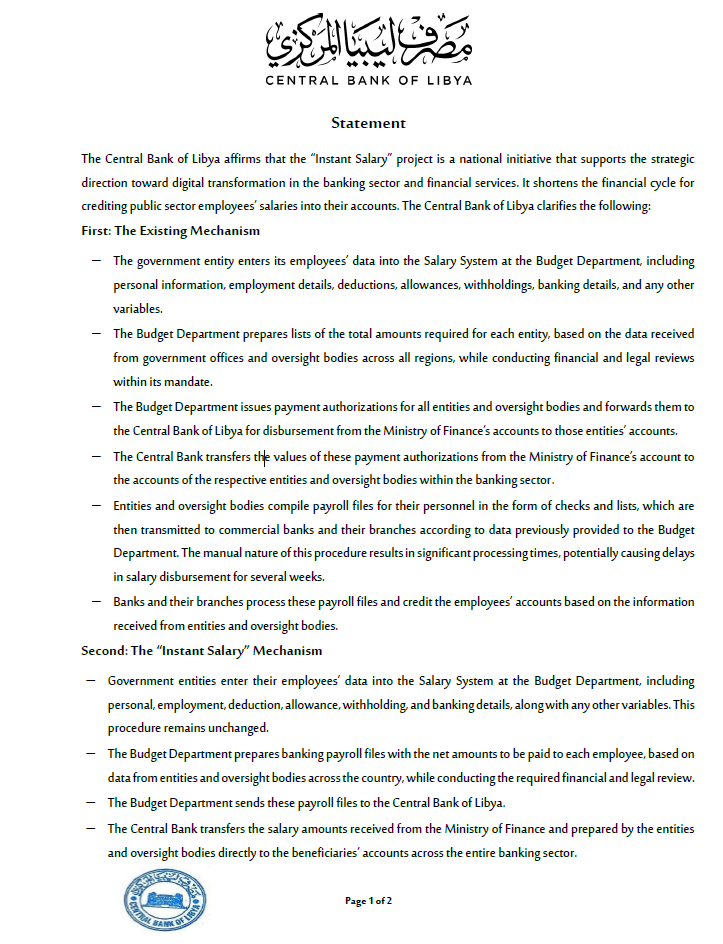
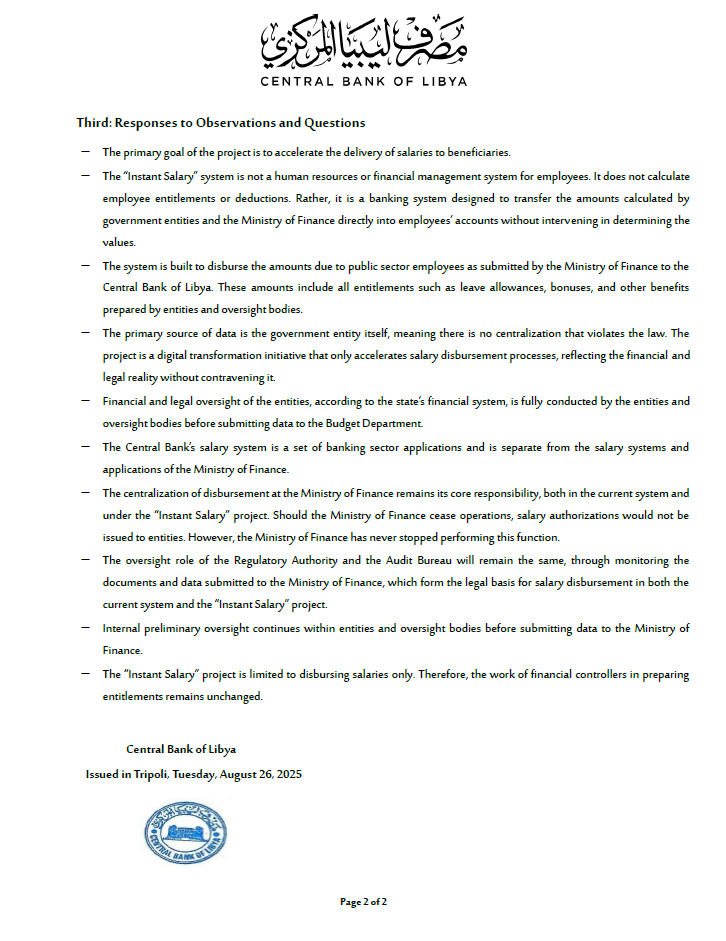
Following the launch of the “Instant Salary” project, the Central Bank of Libya announced that commercial banks executed a total of 894,804 salaries at the start of processing the August payroll on the afternoon of September 1, 2025.
The Ministry of Finance had transferred 904,127 salaries with a total value of 1.797 billion Libyan dinars. The difference between the number of salaries transferred by the Ministry and those executed relates to accounts with issues or cases requiring manual intervention. Full execution details will be forwarded to the Ministry of Finance on Sunday to initiate the necessary adjustments.
The Central Bank of Libya has also published a dashboard for citizens, showing the level of commitment of commercial banks in processing the transferred salaries, accessible through the following link:
https://app.powerbi.com/view?r=eyJrIjoiMmExMmRhZmUtZjQyMi00NDQ4LTg3NjAtNDBiODM1MjA2ZjFhIiwidCI6ImZlMDJmNGE1LWU4NTgtNDA5ZC05MDdlLWJlOTFlMTM5OWQ5OCJ9

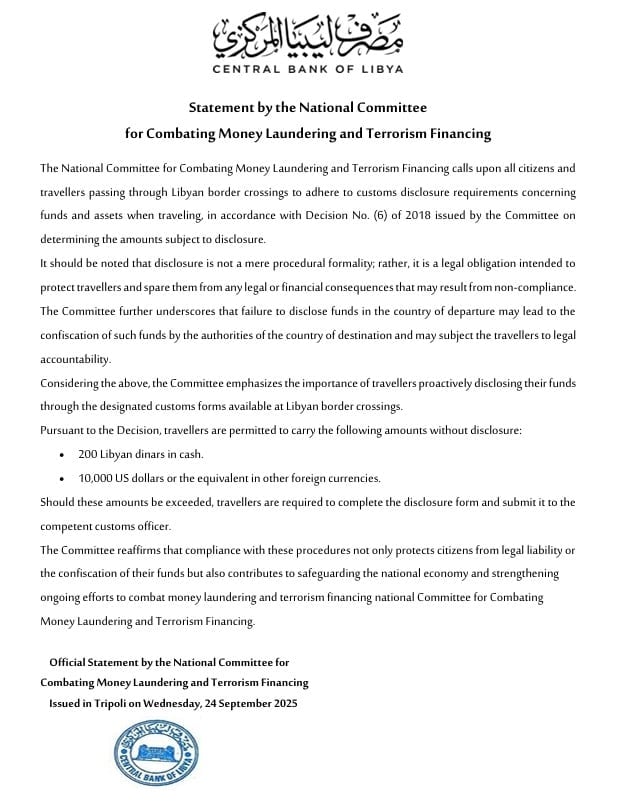
On Wednesday, September 3, 2025, the third regular meeting of the National Committee for Combating Money Laundering and Terrorism Financing was held in Tripoli, chaired by H.E. Naji Mohammed Issa Governor of the Central Bank of Libya and Chairman of the Committee, with the participation of representatives from relevant national entities and institutions.
The meeting focused on following up on the implementation of the Committee’s previous decisions and initiatives, as well as discussing the questionnaire related to the periodic update model in preparation for the upcoming mutual evaluation process. It also reviewed the timetable for the third round of evaluations to be conducted on the State of Libya by the Middle East and North Africa Financial Action Task Force (MENAFATF).
The participants further reviewed the latest developments concerning the adoption of the draft Anti-Money Laundering and Counter Terrorism Financing Law, currently submitted to the legislative authority This draft law is regarded as a cornerstone for enhancing compliance with international standards and represents a crucial requirement in the country’s evaluation process.
The intensification of these meetings comes as part of the national efforts to address the serious risks associated with any potential shortcomings in the mutual evaluation process, which could have severe negative repercussions on Libya’s economic and financial security.
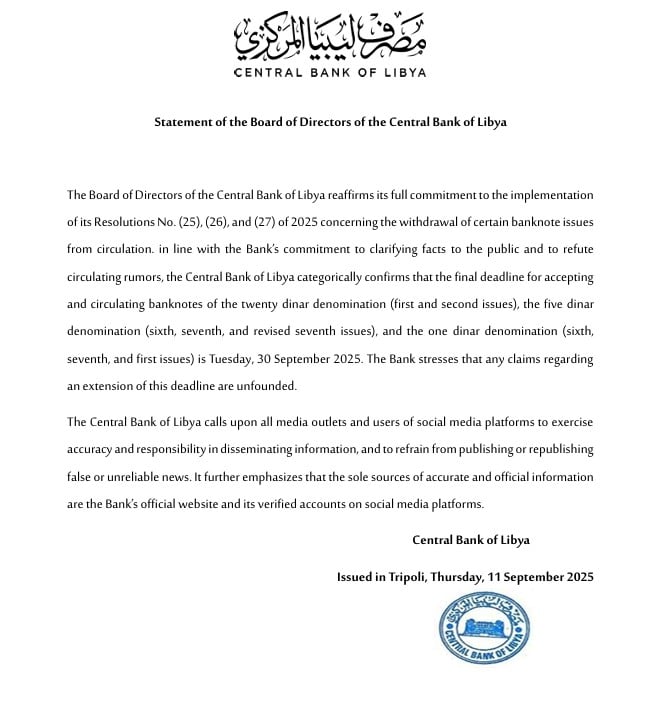
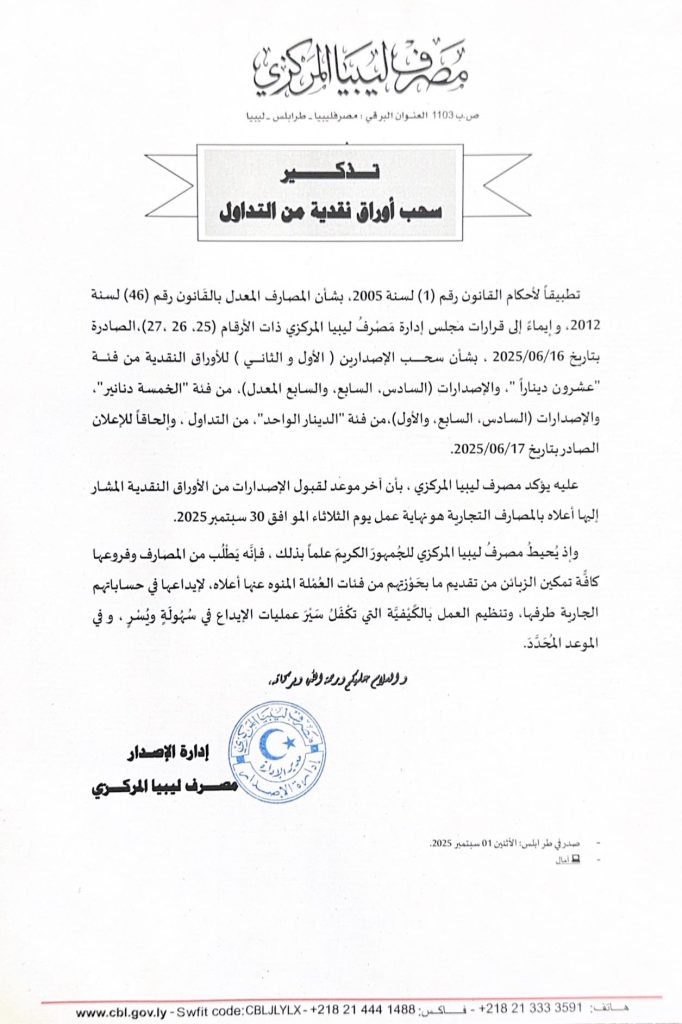
The Central Bank of Libya affirms that the banknote denominations consisting of the twenty-dinar notes (first and second issues), the five-dinar notes (sixth, seventh, and amended seventh issues), and the one-dinar notes (sixth, seventh, and first issues), which have been designated for withdrawal from circulation, remain legal tender and must be accepted in all daily transactions, including by commercial banks, until the scheduled withdrawal deadline of September 30, 2025.
The Central Bank assures citizens that all their rights are fully preserved, and no holder of these banknotes will incur any loss provided they are deposited with commercial banks within the specified deadlines. Commercial banks will begin receiving these denominations, depositing them with the Central Bank in stages, and providing replacements up to September 30, 2025. Citizens are advised to rely solely on the official statements and clarifications issued by the Central Bank of Libya, as it is the only authorized and reliable source of information.

Governor of the Central Bank of Libya, H.E. Naji Mohammed Issa Governor of the Central Bank of Libya, in the presence of the Minister of Finance of the Government of National Unity, Mr. Khaled Al-Mabrouk Abdullah, officially launched, the “Instant Salary” system dedicated to the disbursement of public sector employees’ salaries on Monday, September 1, 2025, in Tripoli.
During the launch ceremony, the Governor of the Central Bank of Libya called on the relevant entities to complete the procedures for submitting their data to ensure that the salaries of September are included in the electronic system. He expressed his hope that this step would contribute to facilitating the process of disbursing the salaries of nearly 900,000 employees, noting that notification messages have already started reaching public sector employees.
Mr. Governor further explained that the Central Bank of Libya will announce via its official website once the salary transfers are fully completed, pointing out that a dedicated electronic link has been provided to enable employees to inquire about their salary amounts and identify the banks to which they have been transferred. He also emphasized that this project represents an initial step towards further reforms in the field of public spending and public finance as a whole.
At the conclusion of the ceremony, the Minister of Finance presented a shield of appreciation to the Governor of the Central Bank of Libya in recognition of his efforts in supporting the digital transformation process and ensuring the success of the initiative to facilitate salary disbursement for citizens.

H.E. Naji Mohammed Issa Governor of the Central Bank of Libya, held an extensive meeting with a number of general managers of commercial banks, in the presence of Moamalat Company and with the participation of the relevant departments of the Central Bank on Tuesday, August 26, 2025.
The meeting discussed the latest developments in expanding electronic payment services and reviewed related performance indicators, in addition to assessing the readiness of the banking sector to provide advanced digital financial services that meet market needs
The discussions also addressed the importance of broadening the scope of electronic payment applications to cover vital sectors such as schools and universities, hospitals and clinics, bakeries, airlines, as well as various commercial activities. This expansion aims to facilitate citizens’ daily transactions and reduce reliance on cash.
The meeting further emphasized the importance of following up on the legislative and regulatory framework that ensures consumer protection and supports a secure and transparent financial environment.
During the meeting, the Governor stressed that electronic payment represents a fundamental pillar in modernizing the banking and financial sector, underlining the need to accelerate the pace of digital transformation in banks and to strengthen customer confidence in using modern payment tools.
The Governor also reaffirmed the readiness of the banking sector to implement the “Instant Salary” project immediately once salaries are transferred by the Ministry of Finance and credited directly to citizens’ accounts.
In addition, the Governor issued strict instructions to commercial banks not to provide customers with any banknotes scheduled to be withdrawn from circulation as of September 30, 2025, starting from next week, and to ensure the exclusive circulation of the new banknote issues that will be supplied to them this week by the Issuance Department of the Central Bank of Libya.

The Central Bank of Libya affirms that the “Instant Salary” service relies on automated data matching through information provided by the Ministry of Finance and does not require employees to carry out any direct registration. The platform’s function is limited to enabling users to view the status of account matching only, without having any impact on salary disbursement. Moreover, not having an account on the Personal Purposes Platform does not constitute an obstacle to receiving salaries, while SMS notifications related to the service are being gradually sent to the targeted individuals.
For further clarification, please refer to the Questions and Answers regarding the service via the following link:
https://cbl.gov.ly/faq-category/ratebak/