
Author: afarhat


Governor of the Central Bank of Libya grants final and preliminary licenses to a number of exchange offices and companies
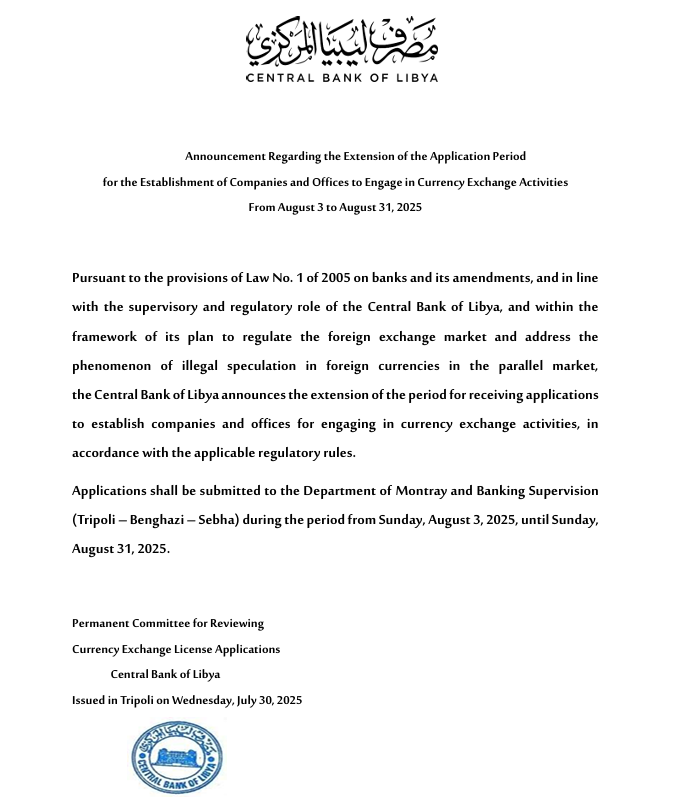
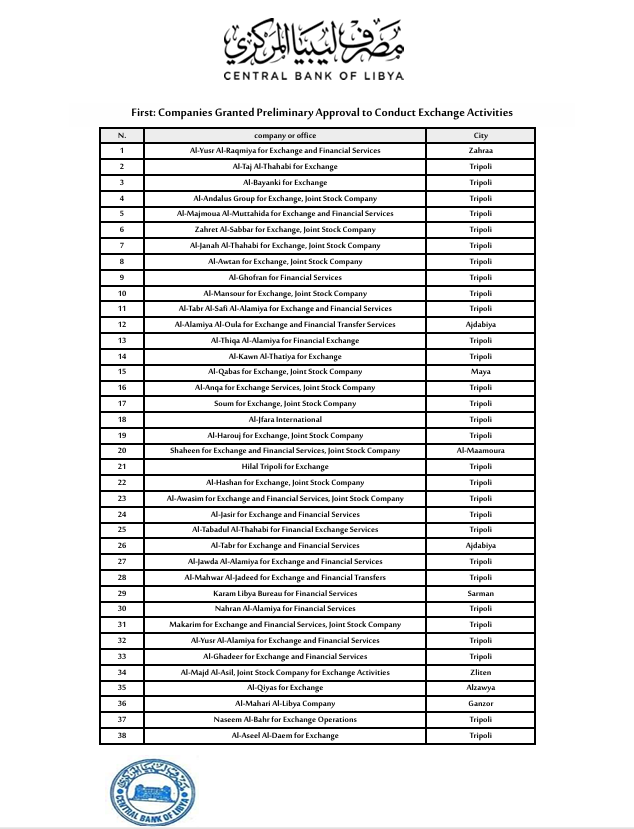
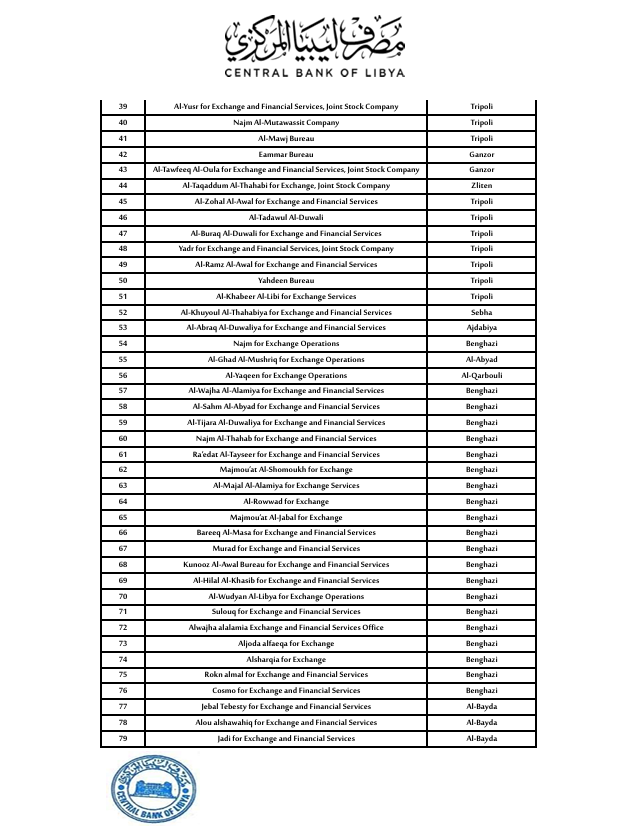
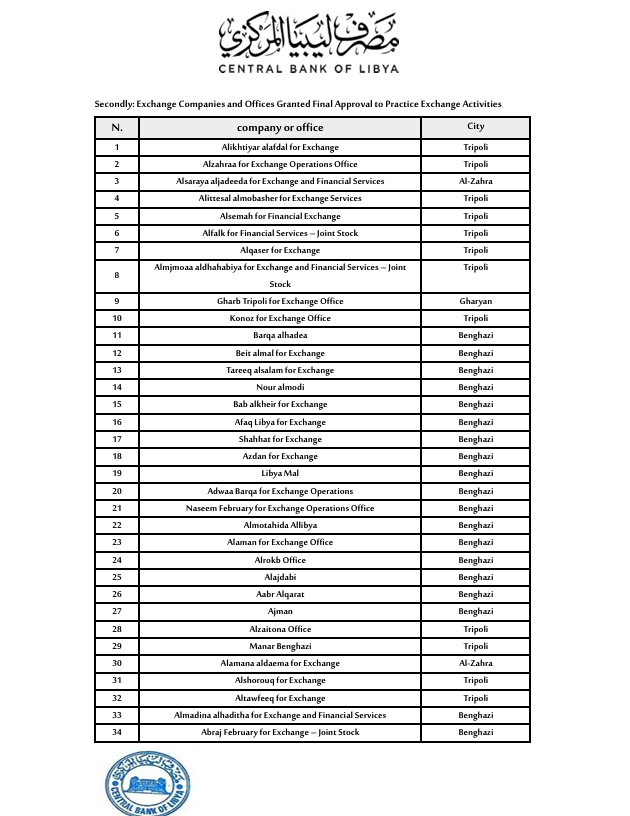
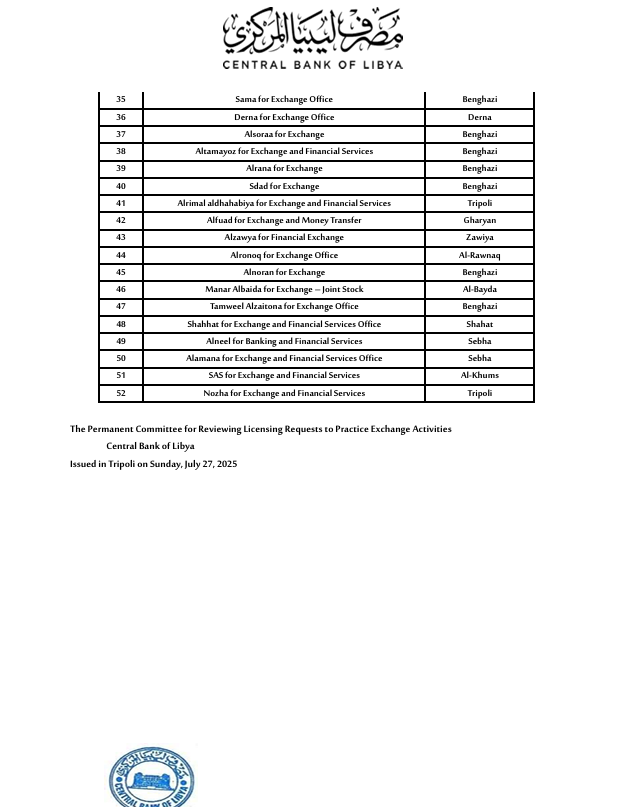
As part of the Central Bank of Libya’s plan to activate the role of exchange companies and offices, and further to the previous announcement regarding the licensing of 135 exchange entities, the Central Bank of Libya announces that the Governor, H.E. Mr. Naji Mohammed Issa, has approved the issuance of new final licenses for 52 additional exchange offices and companies . This brings the total number of licensed entities to 187, covering all regions of Libya.
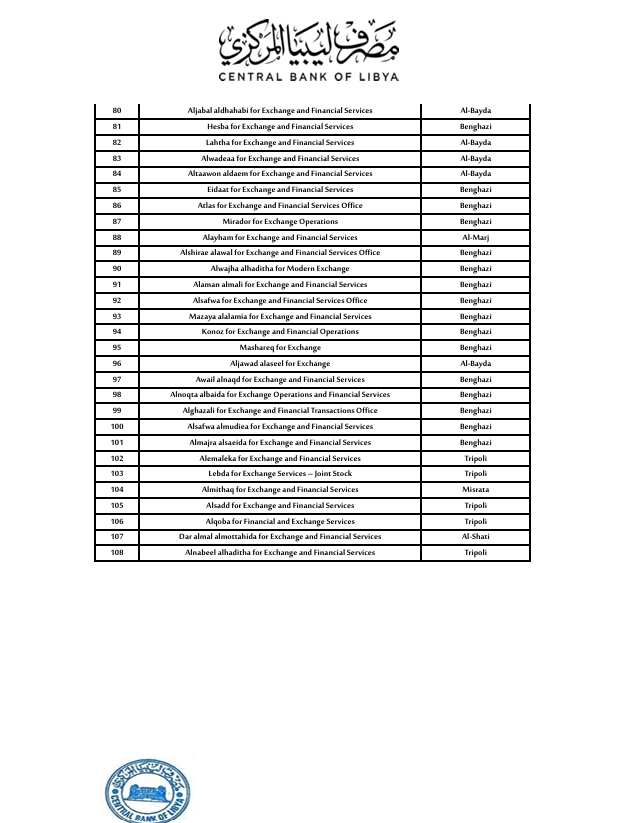
In addition, preliminary licenses have been granted to 108 companies and offices, as detailed in the attached lists.
The Central Bank of Libya renews its call for these licensed entities to attend the scheduled meeting on Sunday, August 3, 2025, at Al-Mahari Hotel, to discuss the operational mechanism for entering the market under the supervision of the Central Bank of Libya.

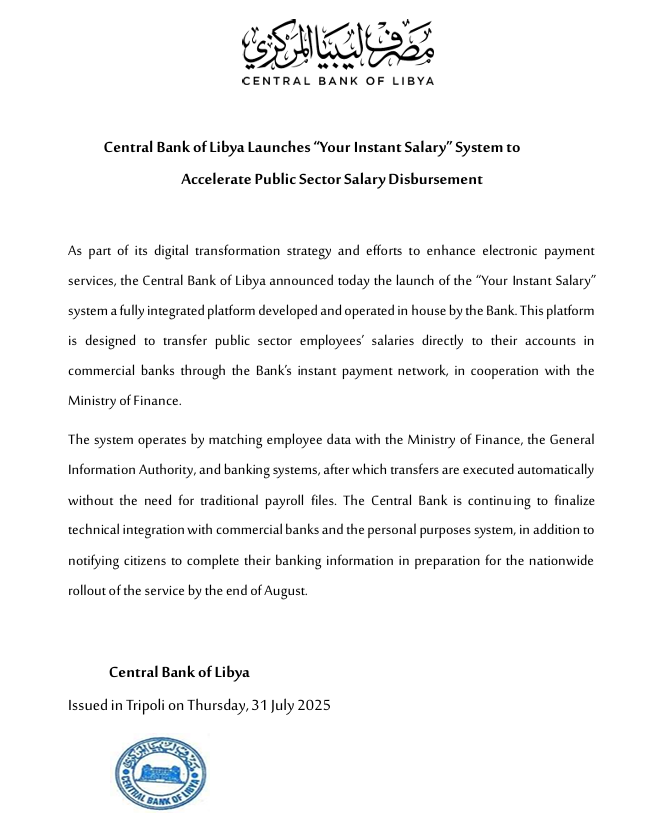
Governor of the Central Bank of Libya and the Minister of Finance agree on automating salary payments and launching joint projects for digital transformation
Automating the execution of public sector salary payments, advancing the Ministry of Finance’s digital transformation projects, and initiating the design and development of a unified treasury account system were the key topics discussed during the meeting between H.E. Mr. Naji Mohammed Issa, Governor of the Central Bank of Libya, and Dr. Khaled Al-Mabrouk Abdullah, Minister of Finance of the Government of National Unity on Sunday, July 27, 2025.
The discussions focused on several joint initiatives aimed at aligning monetary and fiscal policies in a manner that enhances overall economic stability it was attended by the Minister of Finance and senior directors from both institutions..
Both parties agreed to begin the automated and immediate disbursement of public sector salaries across all ministries and institutions starting with the September payroll. Additionally, joint working groups will be established between the Central Bank and the Ministry of Finance to advance the implementation of modern digital transformation strategies.

Central Bank of Libya announces the launch of registration service for companies wishing to obtain foreign exchange
As part of efforts to develop the mechanism for issuing letters of credit and to ensure transparency and fairness in access to foreign exchange, the Central Bank of Libya announces the launch of a registration service for companies wishing to obtain foreign exchange through the Foreign Currency Management System (fcms.cbl.gov.ly). This will begin with a one week pilot phase before officially going live on August 1st.
Companies must have a valid CBL key (bank code), and authorized users on the registered bank account must be granted access to add company accounts. This is conditional on verifying their personal information national ID number, phone number, and passport number registered within the CBL key system and the FCMS platform.
Registration on this platform requires the CBL key and the company’s bank account IBAN number.
The Central Bank will also produce and publish a tutorial video explaining how to use the platform.

Governor of the Central Bank of Libya meets with the Minister of Labor and Rehabilitation and the Minister of Education
Regulating the expatriate labor market and eliminating the shadow economy in Libya, along with the Central Bank’s efforts to achieve the vision of digital transformation, were the key topics of discussion during the meeting between H.E. Mr. Naji Mohammed Issa, Governor of the Central Bank of Libya, and Eng. Ali Abed Al-Ridha, Minister of Labor and Rehabilitation and Minister of Education, with the participation of directors of relevant departments from both sides, general managers of several commercial banks, and the General Manager of Moamalat Financial Services Company on Thursday, July 17, 2025.
The meeting addressed the Ministry of Labor and Rehabilitation’s efforts to document expatriate workers by requiring all foreign laborers to obtain legal work permits linked to a national data system. Discussions also included combating illegal employment and tightening oversight on establishments employing unlicensed workers.
It was agreed to form a joint working group between the Central Bank of Libya and the Ministry of Labor and Rehabilitation to design a system utilizing electronic platforms to track work permits and verify the identities of expatriate workers. The aim is to integrate these workers into the formal banking system, thereby stimulating the official economy. A national awareness campaign targeting employers and workers will also be launched to highlight the importance of legal employment and the risks associated with the informal economy. This is expected to enhance employment opportunities for Libyans, reduce dependency on foreign labor in certain sectors through training and recruitment, reform the financial system, and combat tax evasion and money laundering, all to curb the parallel economy.
Regarding the education sector, the attendees discussed the Central Bank’s efforts to promote electronic payment tools and move toward genuine digital transformation. The Governor had previously addressed the Minister on July 10, urging all entities under the Ministry of Education to adopt and implement approved electronic payment methods and to provide electronic points of sale (PoS) at their premises. It was agreed to begin providing PoS terminals to educational institutions and to offer full support to administrators of these institutions in utilizing various electronic payment methods.
In conclusion, the Governor commended the Minister’s cooperation and praised his efforts in advancing several key sectors such as labor and rehabilitation, civil service, and education.

Governor of the Central Bank of Libya meets with the President of the Audit Bureau
As part of institutional cooperation between regulatory and financial bodies, H.E. Mr. Naji Mohammed Issa, Governor of the Central Bank of Liby, met , with Mr. Khaled Ahmed Shakshak, President of the Audit Bureau, to discuss a number of issues related to overall performance and oversight of the financial and economic sectors. The meeting was attended by several officials from both institutions on, Wednesday, July 16, 2025.
The discussions focused on the measures taken by the Central Bank of Libya within its mandate to manage monetary policy and maintain financial and monetary stability, in addition to following up on the collection of oil revenues, which represent one of the most important public resources for the state.
The two parties also discussed the importance of securing the necessary funding to develop the oil sector and increase its production capacity, given its pivotal role in supporting the national economy. They emphasized the need to adhere to the legal frameworks and regulatory guidelines to ensure sustainability and promote recovery and growth.
The meeting further addressed a number of observations related to the performance of some commercial banks, with a mutual agreement on the importance of resolving these issues in a way that strengthens the soundness of the banking sector and reinforces principles of transparency and institutional compliance.
Both sides underscored the importance of coordination between the Central Bank of Libya and the Audit Bureau in monitoring public financial performance and safeguarding public funds, thereby enhancing public trust in state institutions and improving their ability to respond to economic challenges.
The meeting also touched on the final preparations for launching a joint training program, in cooperation with the Institute of Banking Studies, aimed at enhancing the technical skills of Audit Bureau staff in specialized financial and banking fields.
At the conclusion of the meeting, the President of the Audit Bureau presented the Governor of the Central Bank with audit opinion reports and audited financial statements of the Central Bank for the years 2011 to 2016, which had been approved by the Audit Bureau. These reports were prepared in accordance with international auditing standards, reflecting the Bureau’s commitment to its legal responsibilities and strengthening the culture of transparency and accountability.
It is worth noting that this meeting is part of ongoing efforts to enhance institutional coordination and develop the financial and regulatory oversight system in a manner that meets current challenges and serves the national interest.


The Governor of the Central Bank of Libya discusses performance indicators with banks and electronic payment companies, and directs the expansion of instant payment services as part of the digital transformation plan
Enhancing electronic payment services, improving the quality of banking services, and monitoring the performance of banks and electronic payment companies in keeping pace with the digital transformation plan were the key themes of the meeting held by H.E. Mr. Naji Mohammed Issa, Governor of the Central Bank of Libya. The meeting brought together a number of general managers of commercial banks and representatives of licensed electronic payment companies, in the presence of several directors from the relevant departments of the Central Bank. The meeting was part of the ongoing efforts to follow up on the overall performance related to the use of electronic payment tools and instant payment services, and to review key indicators, developments, and challenges in this area , on Tuesday, July 15, 2025.
During the meeting, electronic payment indicators and statistics were presented, clearly showing significant improvement and notable, encouraging growth in the volume of electronic transactions during the first half of the year. Point-of-sale terminals increased by 92%, while electronic transactions grew by 75% compared to the first half of 2024. These figures reflect the rising adoption of modern payment methods among citizens and the private sector, and affirm the success of the Central Bank’s gradual digital transformation strategy.
The meeting also addressed the necessary preparations for expanding electronic payment services to include additional sectors such as healthcare, education, transportation, labor, and vocational training in the upcoming phase.
In conclusion, the Governor instructed that efforts be made to encourage the expansion of electronic payment services by raising the transfer limits as part of the strategy to promote instant payment services. He also stressed the importance of continuing to facilitate access to these services, regularly evaluating and updating performance to keep pace with rapid developments, and further promoting a culture of electronic payments as a safe and essential option for all segments of society.

The Governor of the Central Bank of Libya opens a workshop titled “The Role of the Banking Sector in Reviving Stalled Housing Projects and construction Development“
H.E. Mr. Naji Mohammed Issa, Governor of the Central Bank of Libya, opens a workshop entitled: “The Role of the Banking Sector in Reviving Stalled Housing Projects and construction Development”
The event was attended by several chairpersons and general managers of commercial banks, as well as representatives from relevant institutions on Sunday, July 13, 2025, in Tripoli.
This workshop underscores the Central Bank of Libya’s commitment to its developmental role in supporting economic recovery and promoting social stability through balanced policies, the creation of a sustainable and enabling financial environment, the facilitation of real estate financing under appropriate regulations, and the support of youth and real estate developers.