afarhat - Page 7 of 20

Author: afarhat

The Central Bank of Libya Signs a Cooperation Agreement with the World Bank under the Reserve Advisory and Management Program (RAMP)

On October 13, 2025,  H.E. Naji Mohammed Issa, Governor of the Central Bank of Libya, signed a cooperation agreement with Mr. Jorge Familiar, Vice President and Treasurer of the World Bank, at the Bank’s headquarters in Washington, D.C. The agreement was concluded under the framework of the Reserve Advisory and Management Partnership (RAMP) program.

The agreement aims to achieve competitive returns on the Central Bank’s foreign currency reserves through the adoption of international best practices in asset allocation, portfolio and risk management, as well as the development of human capital, information infrastructure, accounting frameworks, financial reporting, and legal systems.

By joining the RAMP network which includes more than 90 central banks, sovereign wealth funds, and financial institutions worldwide the Central Bank of Libya strengthens its ability to expand its network of peers in the fields of investment and reserve management. This partnership will facilitate the exchange of expertise and the adoption of globally recognized best practices to enhance the efficiency and effectiveness of managing Libya’s financial assets.

Naji Issa Meets with Kenji Okamura

H.E. Naji Mohammed Issa, Governor of the Central Bank of Libya, and his accompanying delegation met with Mr. Kenji Okamura, Deputy Managing Director of the International Monetary Fund, in the presence of senior IMF department directors On October 13, 2025.

The meeting discussed developments in the global economy and their implications for Libya, as well as the outcomes of the Article IV Consultations for 2025 and the efforts of Libyan institutions in providing the data and information necessary for the success of these consultations. The discussions also covered the Governor’s initiative to address the structural imbalances affecting the Libyan economy and his short term vision for overcoming the crisis through a package of proposed economic reforms, most notably the unification of public spending and the review of monetary, trade, and fiscal policies.

IMF representatives expressed appreciation for the Central Bank of Libya’s efforts and conveyed their readiness to provide technical support and advisory assistance as needed during this critical stage, particularly in areas related to monetary policy, exchange rate stability, strengthening the value of the Libyan dinar, and resolving the cash liquidity crisis.

Mr. Okamura affirmed the IMF’s full understanding of and support for the Central Bank of Libya’s efforts to establish sound and well coordinated policies and measures aimed at addressing the country’s deep rooted structural economic challenges.

Governor of the Central Bank of Libya Meets with the Director of the Middle East and Central Asia Department at the International Monetary Fund

On the sidelines of his participation in the Annual Meetings of the International Monetary Fund and the World Bank, held this week in Washington, D.C., Governor of the Central Bank of Libya, H.E. Naji Mohammed Issa, and his accompanying delegation began their series of meetings on Monday, October 13, 2025, with Mr. Jihad Azour, Director of the Middle East and Central Asia Department at the IMF, and his accompanying team.

During the meeting, discussions focused on the latest economic and financial developments in Libya and the pivotal role played by the Central Bank of Libya in steering the country out of its prolonged crisis. The Governor provided a briefing on the Bank’s efforts to address the ongoing economic challenges, presenting his vision for the upcoming phase and outlining a series of policy measures that will be implemented without directly affecting citizens’ living conditions.

For his part, Mr. Azour and the accompanying team of IMF experts commended the Central Bank of Libya’s initiatives and strategies in managing the crisis, noting that the positive impact of these measures has started to materialize through the Bank’s various initiatives. They also welcomed the progress made toward reaching an agreement among relevant parties on the adoption of a unified state budget for the coming year and on structural reforms expected to gradually strengthen the Libyan dinar against foreign currencies.

In conclusion, participants emphasized the importance of supporting the Governor, the Board of Directors, and the Central Bank of Libya in ensuring the successful implementation of these initiatives both domestically and internationally.

Governor of the Central Bank of Libya meets with the President of the High Council of State

H.E. Naji Mohammed Issa, Governor of the Central Bank of Libya, met today, Wednesday, October 8, 2025, at the headquarters of the High Council of State, with Mr. Mohamed Takala, President of the High Council of State, in the presence of Mr. Hassan Habib, First Deputy President of the Council.

The meeting aimed to review the country’s economic and financial situation and to strengthen cooperation between the Central Bank of Libya and the High Council of State in support of monetary, financial, and economic stability.

Several issues were also discussed, including public spending policies, promoting transparency and fairness in the distribution of resources, and safeguarding public funds.

The Investment and Risk Committee of the Central Bank of Libya reviews foreign currency reserve indicators and launches new investment instruments for commercial banks

The Risk and Investment Committee of the Central Bank of Libya held its third regular meeting today, on Wednesday, October 8, 2025, at the office of Governor, the Chairman of Committee, to discuss a number of strategic items related to the management of the Bank’s assets and foreign investments.

During the meeting, the Committee reviewed the report on the Bank’s assets denominated in foreign currency, which include gold and various financial assets in foreign currencies. The Committee noted the positive impact of the rise in gold and currency prices on the total value of the investment portfolios, which amounted to approximately 98.8 billion U.S. dollars. Of this amount, gold represents a value of 18.164 billion U.S. dollars, or 18.38%, most of which is used as a currency cover. The Committee also reviewed the investment returns achieved from these assets up to September 30, which amounted to 2 billion U.S. dollars, reflecting a positive performance in the management of foreign reserves and mitigating the deficit in oil revenues and the balance of payments resulting from the expansion of foreign exchange spending.

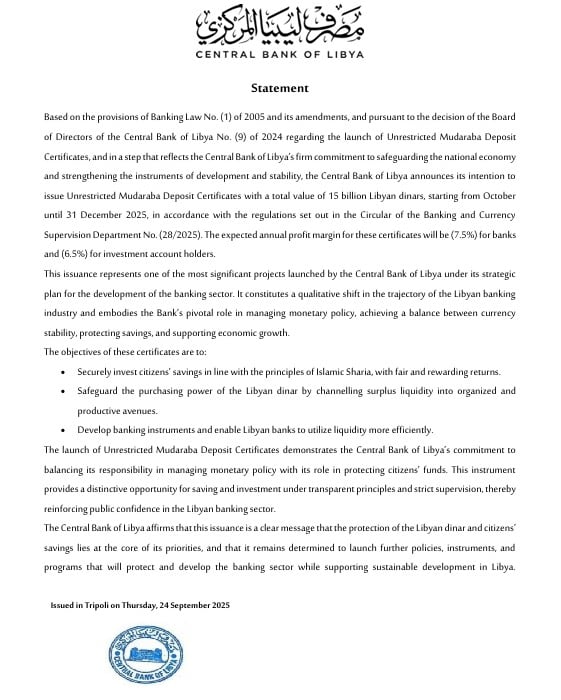
On the other hand, and as a step aimed at enhancing investment instruments, diversifying sources of return for commercial banks, and activating one of the monetary policy tools, the Committee discussed initiating the issuance of unrestricted Mudarabah certificates. It was decided to begin announcing the offering of the first issuance for commercial banks starting from next Sunday, October 12, 2025, reflecting the Bank’s orientation toward expanding the investment base and achieving maximum benefit from the liquidity available in the local market.

This meeting comes as part of the Central Bank of Libya’s commitment to enhancing transparency and efficiency in managing its foreign currency reserves, and to presenting a positive picture of the indicators of monetary, financial, and economic stability in the country, thereby supporting confidence in monetary policy and reinforcing the Bank’s position as a leading financial institution in the region.

The Governor of the Central Bank of Libya meets with the Chairmen of the Boards of Directors and General Managers of commercial banks

H.E. Naji Mohammed Issa Governor of the Central Bank of Libya, held an extensive meeting at the Banking and Supervision Department in Tripoli, with the Chairmen of the Boards of Directors and General Managers of commercial banks on Monday, October 6, 2025,. The meeting was attended by the Directors of Compliance Departments, members of the Board of Directors of the Central Bank of Libya, and heads of relevant departments at the Central Bank, with the participation of Deputy Governor Mr. Maree Al-Barasi via video conference from Benghazi. The meeting came as part of ongoing efforts to follow up on the implementation of banking and supervisory plans for the upcoming phase.

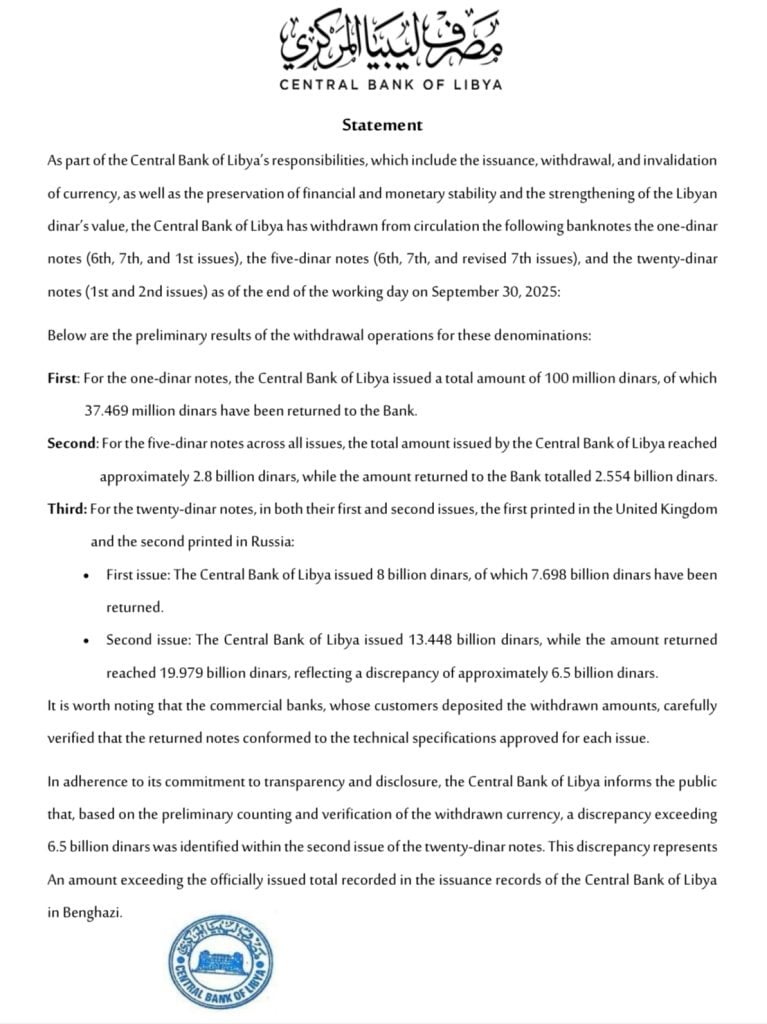
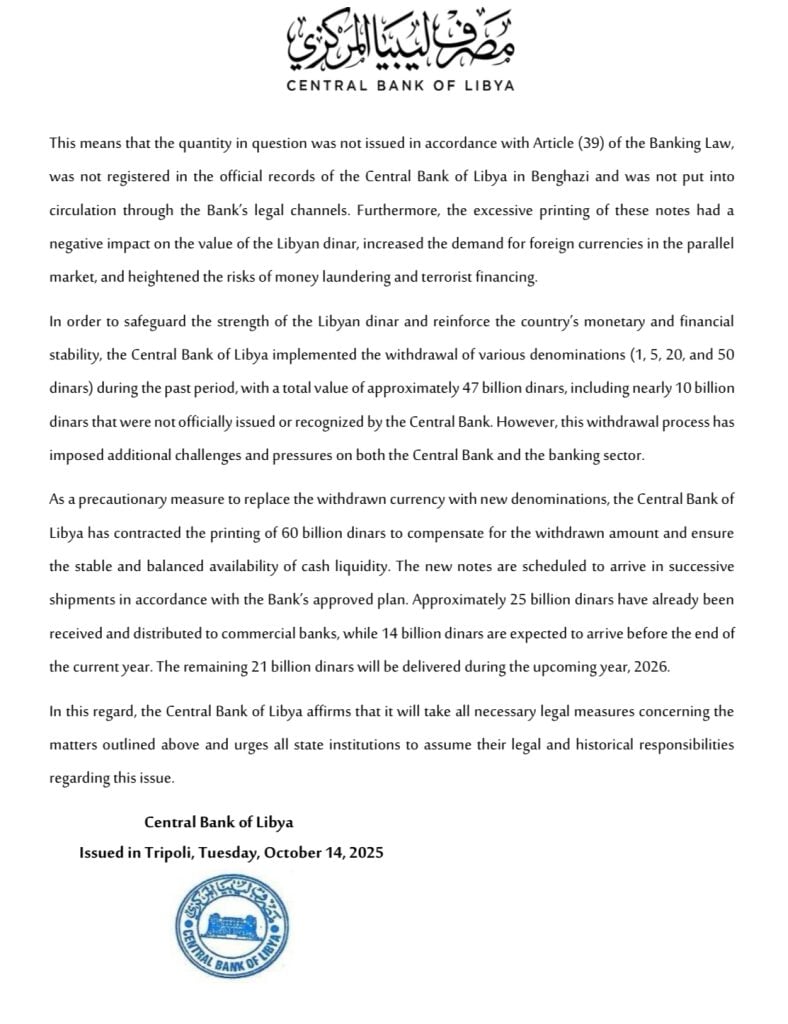
The meeting discussed several key topics, including the regular provision of cash liquidity in accordance with the approved plan, ensuring that the Central Bank will meet all the needs of both banks and citizens, and the successful implementation of the currency withdrawal plan, which contributes to regulating cash circulation and maintaining monetary and financial stability.

Participants also discussed progress in electronic payment indicators to promote the use of modern financial technologies, in line with the Central Bank’s approach toward digital transformation and improving the quality of banking services.

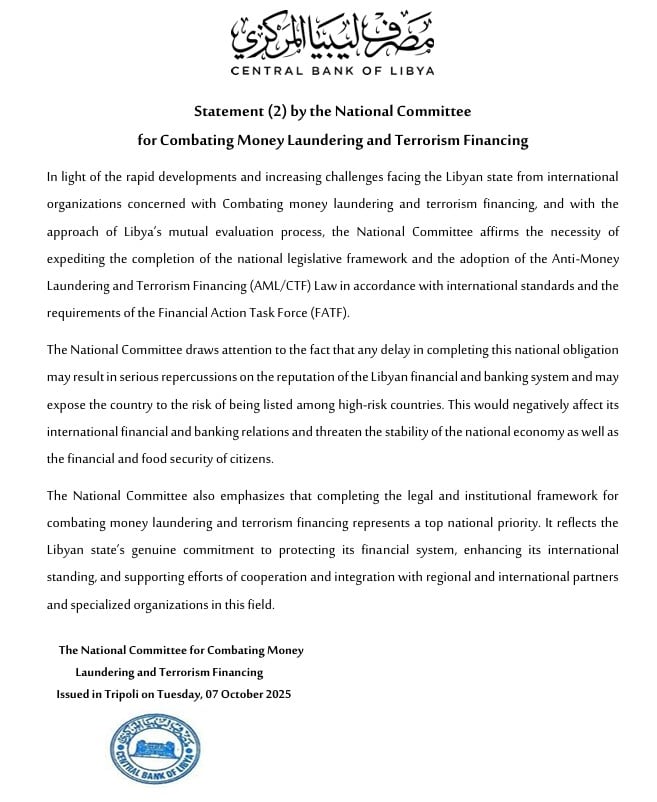
During the meeting, the Governor emphasized the importance of adhering to compliance requirements in accordance with both local and international standards when opening letters of credit and applying anti-money laundering and counter-terrorism financing regulations. He reaffirmed that the Central Bank continues its efforts to ensure the soundness and stability of the banking system and to strengthen public confidence in it.

In conclusion, the Governor stressed the importance of maintaining coordination between the Central Bank and all operating banks to ensure the implementation of approved plans and the achievement of the desired goals for developing the Libyan banking sector.