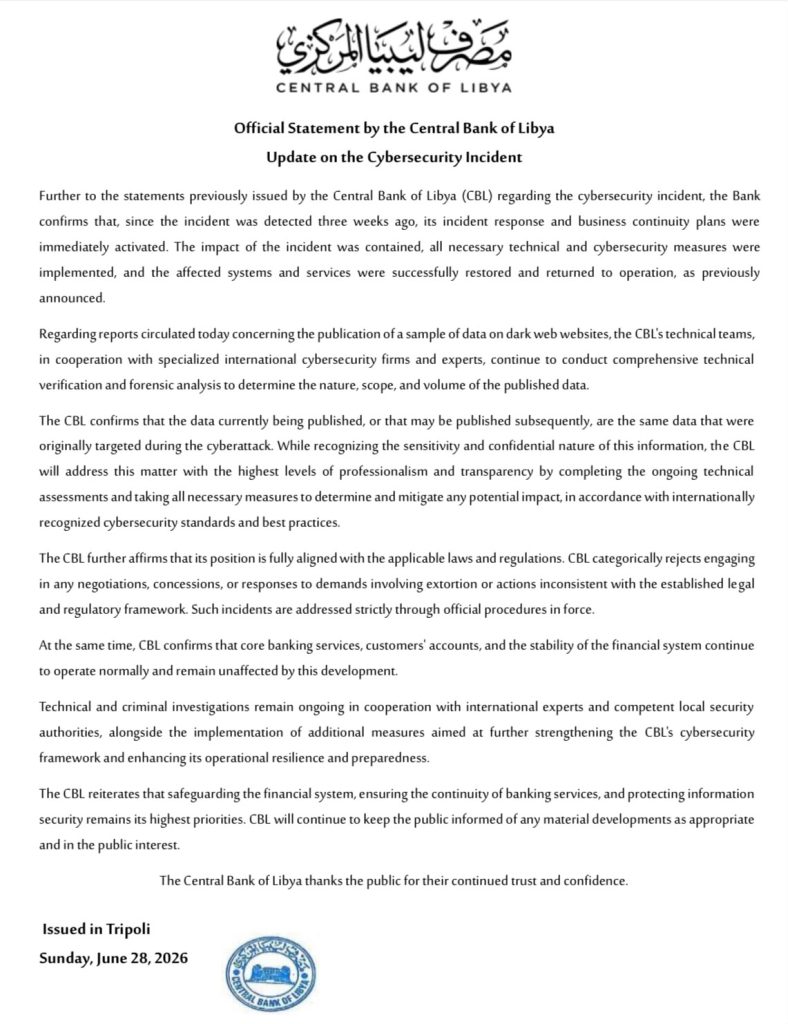
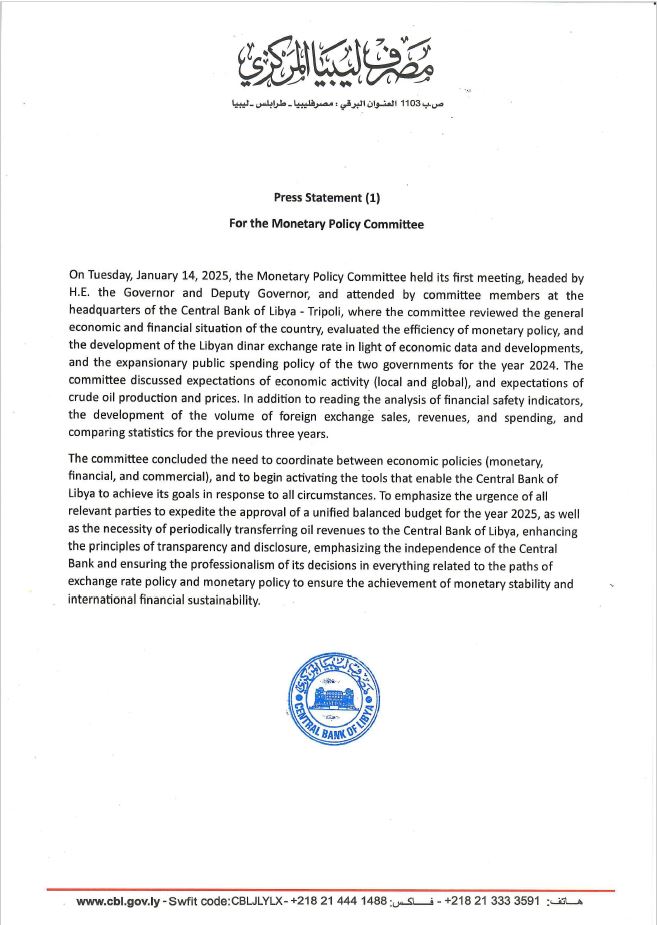
The Monetary Policy Committee held its first meeting of 2026 amid a delicate economic environment characterized by political instability and weak fiscal discipline, which imposes increasing challenges on the Central Bank of Libya in maintaining monetary stability and exchange rate stability.
The meeting reviewed the assessment of measures taken during 2025, developments in the Libyan economy, the use of foreign currency, and anticipated challenges for 2026.
The committee also addressed the regulation and supervision of exchange activities, as well as the readiness of exchange offices and companies to operate in order to enhance discipline and transparency in the foreign currency market.
Additionally, the committee examined technical reports and risks associated with the expansion of public spending and the rise of public debt, and their impact on the level of reserves.
In light of these findings, the committee approved a package of reforms in monetary and trade policy aimed at supporting market stability and exchange rates, containing the parallel market, protecting reserves, and enhancing the effectiveness of monetary policy in 2026. The recommendations will be presented to the Board of Directors of the Central Bank of Libya at its first meeting of the year.
H.E. Naji Mohammed Issa, Governor of the Central Bank of Libya, Meets with the Chairman and Members of Finance Committee of House of Representatives on Tuesday, 4th of February 2025. The discussions focused on the mechanism for government spending in 2025 and its unification, with an emphasis on ensuring the regular payment of salaries in accordance with the letter from the Chairman of Finance Committee addressed to the Chair of the House of Representatives. This will continue until reforms are approved and actual expenditure for 2025 is determined at the beginning of April. Additionally, the meeting covered the overall financial and economic situation, particularly the impact of public spending on increasing demand for foreign currency, pressures on the exchange rate, and foreign currency reserves.
The Chairman of Finance Committee reaffirmed his support for the measures taken by the Central Bank of Libya in collaboration with relevant Libyan ministries and institutions, including the Audit Bureau, the Office of the Attorney General, the National Oil Corporation, and the Ministry of Economy. In particular, he highlighted the importance of ensuring the regular flow of oil revenues and regulating import activities exclusively through approved banking instruments.
Further, the members of the Finance Committee expressed their support for the Central Bank of Libya’s efforts, emphasizing their commitment to holding successive meetings to further these objectives.
The Central Bank of Libya has welcomed the statement issued by the International Monetary Fund (IMF) delegation following the conclusion of preparatory meetings for the 2025 Article IV Consultations in Tunis. The statement addressed recent economic developments and reform priorities in Libya. The IMF commended the September agreement to resolve the leadership dispute within the Central Bank as a significant milestone, enabling enhanced governance and stability within the financial sector.
The IMF highlighted the CBL’s efforts to narrow the exchange rate gap between the official and parallel markets and to enhance liquidity, emphasizing the importance of fiscal discipline through the adoption of a unified 2025 budget to optimize resource allocation. Discussions underscored the need for governance reforms and the development of monetary tools to ensure the efficient functioning of financial markets.
Moreover, the IMF stressed the urgency of structural reforms, particularly in addressing energy subsidies, which account for 20% of GDP, and fostering private-sector-led growth to reduce reliance on the oil sector. The CBL reaffirmed its commitment to collaborating with the IMF and other international and regional partners to implement these reforms, strengthen the resilience of the financial sector, and diversify the economy.
Monetary and trade policies harmonize and consolidate efforts to address economic volatility and stabilize prices ,according to the objectives of Central Bank of Libya’s strategy to control inflation variables and exchange rates. This was emphasized during the meeting between the Governor of Central Bank of Libya, H.E Naji Mohamed Issa, and the Minister of Economy and Trade of the Government of National Unity, Mohamed Al-Hawij, on Monday 18th November 2024.
The meeting resulted in an agreement to establish a joint working group comprising economic researchers. This group will focus on studying the market’s needs for goods and services, encouraging local industries, and proposing practical and sustainable solutions.
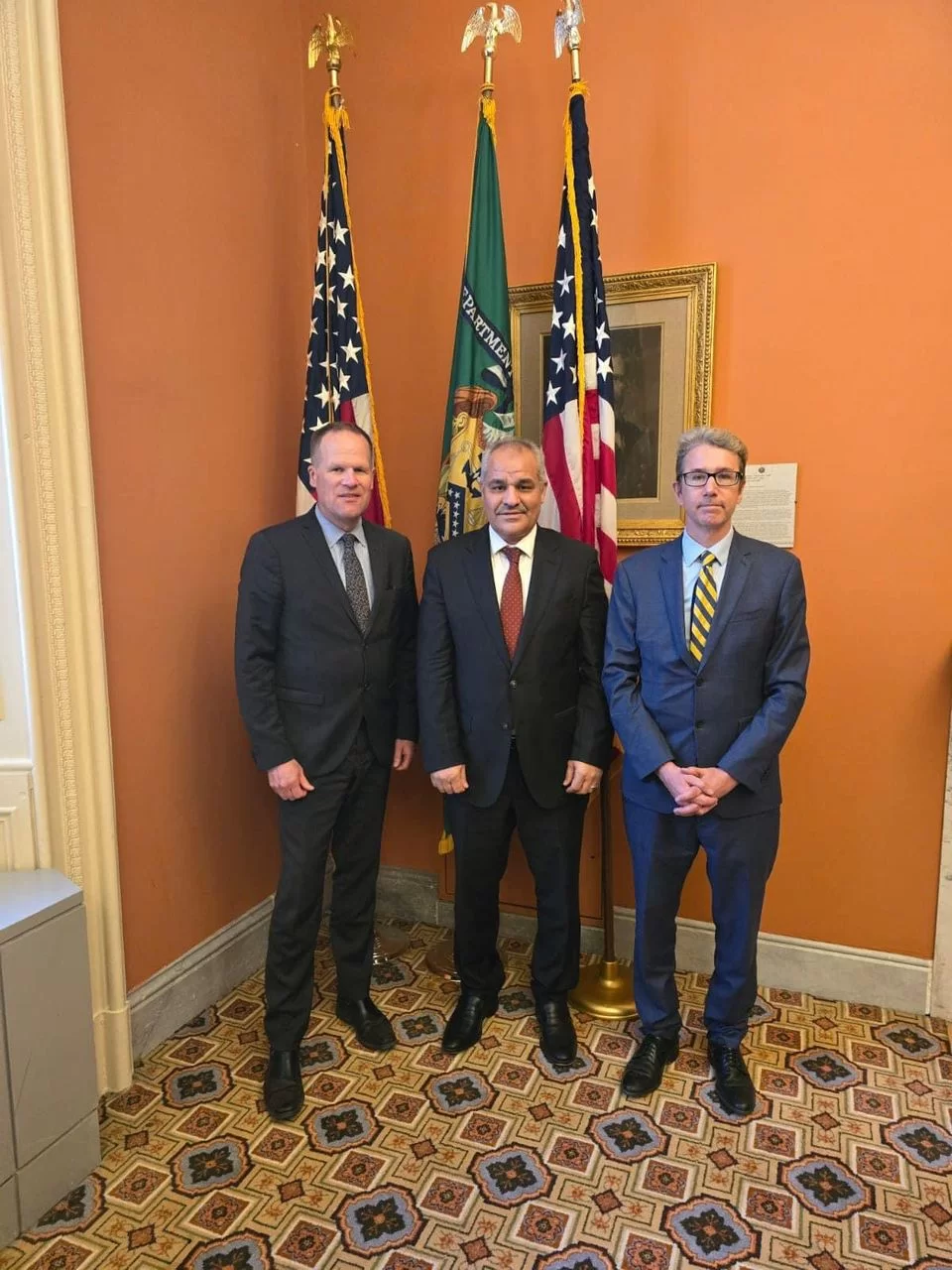
H.E. Naji Mohammed Issa, Governor of the Central Bank of Libya, and his accompanying team held a meeting with Mr. Eric Meyer, Assistant Secretary of the U.S. Department of Treasury for the Middle East and Africa, and Mr. Scott Rembrandt, the Assistant Secretary of the U.S. Department of Treasury for Strategic Policy and Anti-Money Laundering and Counter-Terrorism Financing, along with their teams on Monday, 28th of October, 2024, at the U.S. Department of the Treasury in Washington, D.C.
The key points of the meeting included welcoming the appointment of the Governor, Deputy Governor, and Board of Directors of the Central Bank of Libya, discussing the positive situation following the restoration of relations with correspondent banks, outlining the Central Bank of Libya’s plans for the upcoming months, which encompass providing liquidity, enhancing electronic payment systems, strengthening the Libyan dinar, managing the foreign exchange market, establishing a governance framework for the banking sector, and reinforcing anti-money laundering and counter-terrorism financing controls.
Additionally, the importance of initiating discussions to develop a practical framework for a unified budget for the year 2025 was emphasized, along with a medium-term economic vision. The meeting also addressed activating roles of economic policies—monetary, fiscal, and trade and ensuring their alignment to stimulate economic growth and development. Furthermore, discussions were held on enhancing efforts to implement compliance requirements and combat money laundering and terrorism financing to ensure the safety of banking and financial transfers.
H.E. Naji Mohammed Issa, Governor of the Central Bank of Libya, and his accompanying team met with U.S. Deputy Assistant Secretary of State, Mr. Joshua Harris, and U.S. Special Envoy to Libya, Ambassador Richard Norland, along with their team on the 28th of October, 2024. The Deputy Assistant Secretary and the Special Envoy extended their congratulations on the recent appointments of the Governor, Deputy Governor, and the Central Bank of Libya’s Board of Directors, along with the progress made in strengthening transparency and implementing good governance, supporting the institution’s independence from political disputes. They also welcomed the Central Bank’s plans to enhance cash availability, improve banking service quality, regulate the foreign exchange market, and reinforce governance within Libya’s banking sector. Additionally, they emphasized collaboration on economic policies to achieve stability for the country and reaffirmed their support for the Central Bank’s leadership and autonomy.