Abdulfatah - Page 2 of 16

Author: Abdulfatah

Tripoli Hosts the Fifth Arab Conference on Savings and Financial Literacy

The Governor of the Central Bank of Libya, H.E. Naji Mohammed Issa, inaugurated this morning, Monday, September 7, 2026, the Fifth Arab Conference on Savings and Financial Literacy, held in Tripoli from September 7 to 9 under the theme “Financial Intelligence in an Era of Transformation,” under the patronage of the Central Bank of Libya and in partnership with Bahrain-based MENA Money.

The conference brings together local, regional, and international financial institutions, Arab central banks, as well as experts and academics, to discuss financial inclusion, digital transformation, enhancing the efficiency of the banking sector, and promoting financial literacy.

The conference also addresses the Central Bank of Libya’s efforts to develop the digital payments ecosystem and financial connectivity projects through the Buna platform and the CIPS system, in addition to cybersecurity initiatives and the study and development of digital currency in Libya.

It also highlights the rapid growth in the use of electronic payment methods and instant transfers, as well as the “Your Salary Instantly” project, which has contributed to accelerating salary disbursements and improving the efficiency of financial services.

The conference will conclude with the announcement of the “Tripoli Declaration for the Arab Alliance for Financial Literacy,” serving as a framework for strengthening Arab cooperation and coordinating efforts in the field of financial literacy, while supporting the advancement of financial inclusion across the region.

Governor of the Central Bank of Libya Meets with the Minister of Economy and Trade of the Government of National Unity to Discuss the Provision of Basic Commodities and the Regulation of Letters of Credit

The Governor of the Central Bank of Libya, H.E. Naji Issa, met at his office with the Minister of Economy and Trade, Mr. Suhail Abu Shiha on Sunday, September 6, 2026,, to follow up on a number of economic issues related to the Libyan market’s needs for basic commodities. They discussed prioritizing these needs for the coming period to ensure they meet the needs of citizens.

During the meeting, they also discussed mechanisms for the flow of letters of credit allocated to finance the import of essential goods and supplies, ensuring the smooth flow of import operations.

The two sides agreed on a number of procedures and measures to support the Central Bank of Libya’s efforts in regulating and facilitating the opening of letters of credit and enhancing coordination among relevant entities. This aims to contribute to price stability in the market and maintain a regular flow of basic commodities. They also agreed to continue coordination between the Central Bank of Libya and the Ministry of Economy and Trade and to take all necessary measures to support economic stability and maintain the balance of the local market.

Governor of the Central Bank of Libya Holds an Expanded Meeting with Commercial Banks and Moamalat Company to Review Liquidity, Foreign Currency Provision, and Electronic Payments

The Governor of the Central Bank of Libya, H.E. Naji Issa, held an expanded meeting at his office on Thursday, 3 September 2026, with a number of commercial banks and Moamalat Company, in the presence of directors of the relevant departments at the Central Bank of Libya. The meeting focused on several priority banking issues, foremost among them cash liquidity, the provision of foreign currency, and the further development of the electronic payments system.

The meeting reviewed the measures taken to ensure adequate cash liquidity at commercial banks and enable them to meet citizens’ needs. It also followed up on the mechanisms adopted by banks for the distribution of foreign currency and the facilitation of citizens’ access to their foreign currency requirements in accordance with the approved regulations and procedures.

Discussions also addressed the performance of the electronic payments system, further expansion in its use, and the enhancement of banks’ operational readiness and the related infrastructure, with the aim of improving the efficiency and speed of banking services. The total gross value of electronic payment transactions processed through various payment systems from 1 January to 31 August 2026 reached approximately 764.9 billion LYD, reflecting the continued growth in the use of electronic payment methods and the expanding scope of digital banking services.

During the meeting, the Governor emphasized the importance of full compliance with the instructions and regulations issued by the Central Bank of Libya, while continuing to raise performance standards and improve the quality of services provided to citizens.

The Governor also stressed the need for continuous coordination between the Central Bank of Libya and commercial banks, as well as prompt action to address any bottlenecks that may affect banking services. He further underscored the importance of ongoing monitoring of banks’ performance to ensure the provision of more efficient and timely banking services to citizens.

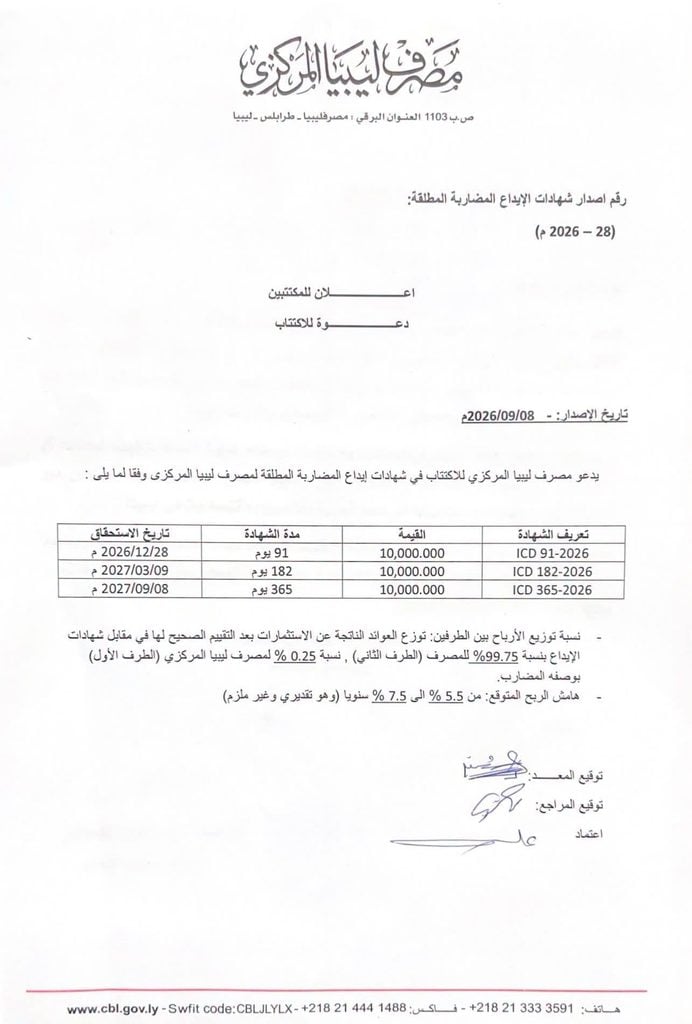
Announcement:

The Central Bank of Libya announces its invitation to commercial banks to subscribe to Issue No. (28–2026) of unrestricted Mudaraba Deposit Certificates, in accordance with the procedures and controls followed in previous issuances, and in line with the tenors and maturity dates specified in the subscription announcement.

Screenshot

The Central Bank of Libya announces the commencement of August salary payments through the “Your Salary Instantly” system

The Central Bank of Libya confirms receiving the August salary payment authorizations from the Ministry of Finance, and these are currently being transferred to commercial banks for immediate processing via the “Your Salary Instantly” system. This system allows citizens to track their salary payments with complete transparency.

According to the latest data, the number of public sector employees registered in the project reached approximately 1.75 million by August, compared to 2.2 million previously, representing a 79% participation rate.

The Central Bank continues to encourage sectors that have not yet joined the project to do so, highlighting its ease of access to salaries and its role in safeguarding public funds.

The “Your Salary Instantly” project is part of the efforts to digitally transform and enhance transparency within the public financial management system, ensuring that salaries reach their recipients on time without delay.

Citizens can inquire about their salary status through the Citizens’ Platform at the following link: https://fcms.cbl.gov.ly

They can also follow statistics on commercial bank salary disbursements at the following link: https://cbl.gov.ly/salary

The Central Bank continues to develop the project by automating the mechanism for receiving complaints and resolving issues related to undisbursed salaries, in cooperation with the Ministry of Finance.

The Central Bank of Libya reaffirms its commitment to developing digital banking services and improving the efficiency of disbursement procedures in line with the requirements of the digital transformation in the financial sector.

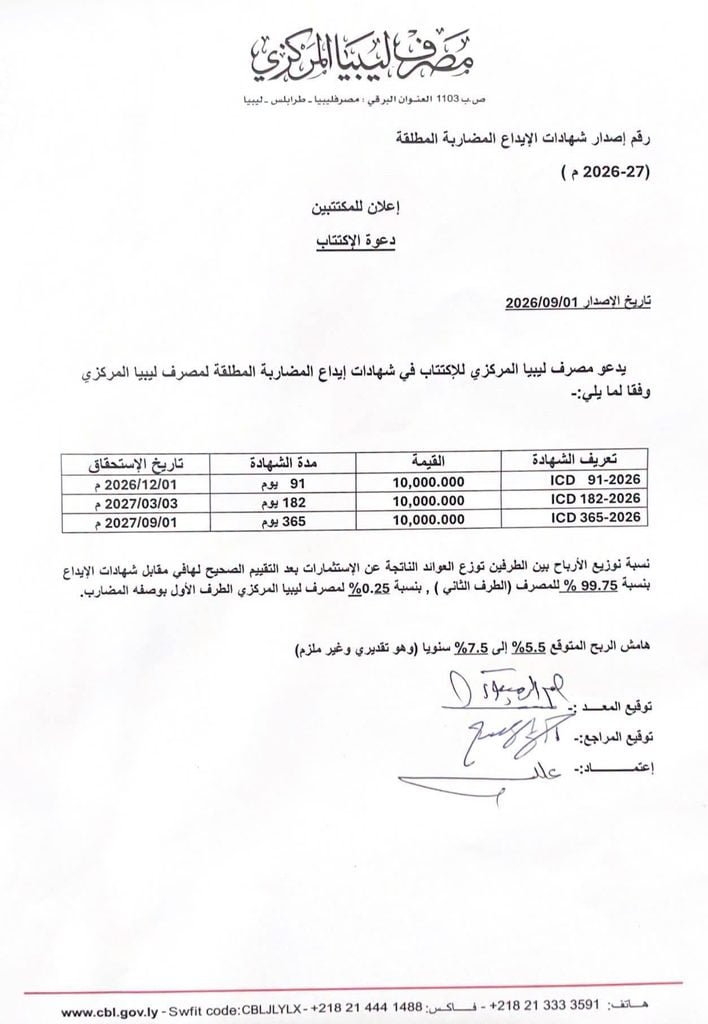
Announcement:

The Central Bank of Libya announces its invitation to commercial banks to subscribe to Issue No. (27–2026) of unrestricted Mudaraba Deposit Certificates, in accordance with the procedures and controls followed in previous issuances, and in line with the tenors and maturity dates specified in the subscription announcement.

Screenshot

Governor of the Central Bank of Libya Meets with the Minister of Finance of the Government of National Unity to Discuss Coordination of Fiscal and Monetary Policies and Follow-up on the Implementation of the Unified Development Agreement

Governor of the Central Bank of Libya, H.E. Naji Issa, met on Monday, August 24, 2026, at his office with the Minister of Finance of the Government of National Unity, Mr. Rashid Abu Ghafa, to follow up on matters related to fiscal and monetary policies, with the aim of enhancing coordination and synergy among state institutions.

The meeting addressed the monitoring of public revenue and expenditure, procedures related to the implementation of fiscal policy, and a number of priority economic and financial issues, most notably the measures taken to implement the Unified Development Agreement and adherence to its provisions.

Both sides emphasized the importance of integrating efforts between fiscal and monetary policy and working to address any obstacles that may hinder the implementation of the agreed-upon procedures and programs, in order to support the achievement of economic and financial stability.

Governor of the Central Bank of Libya Meets with the Senior Advisor for Libyan Affairs at the US State Department to Discuss Economic Developments and Financial Reforms

The Governor of the Central Bank of Libya, H.E. Naji Issa, on Monday, August 24, 2026, at his office with Mr. Jeremy Burnett, Senior Advisor for Libyan Affairs at the US State Department, to review the latest financial and economic developments, follow up on the implementation of the Unified Development Agreement and adherence to its provisions, to discuss the importance of the financial and economic reforms being implemented by the Central Bank of Libya to achieve financial and economic stability, and reaffirm the independence of the Central Bank and its management.

Governor of the Central Bank of Libya Meets with the Prime Minister of the Government of National Unity to Discuss the Economic Situation and Enhance Coordination Between Fiscal and Monetary Policies

Governor of the Central Bank of Libya, H.E. Naji Issa, met on Sunday, August 23, 2026, at his office with the Prime Minister of the Government of National Unity, Engineer Abdulhamid Dbeibah, in the presence of the Minister of Transportation and the Minister of State for Communication and Political Affairs. The meeting addressed the economic and financial situation in the country and ways to enhance integration and coordination between fiscal and monetary policies.

The meeting also covered monitoring the status of public revenues and expenditures, reviewing the procedures related to implementing the provisions of the Unified Development Agreement, and assessing the extent of compliance with its stipulations.

The Prime Minister affirmed the Government of National Unity’s support for the Unified Development Agreement and its commitment to its full implementation. He stressed the importance of identifying shortcomings and their causes in the implementation process and working to address them to ensure the achievement of the objectives for which the agreement was adopted.

Those present also emphasized the importance of continued coordination between the Central Bank and the government and monitoring the implementation of agreed-upon measures to support financial and economic stability and serve the public interest.

Governor of the Central Bank of Libya Meets French President’s Special Envoy to Libya to Discuss Economic Developments and Strengthen Banking Cooperation

Governor of the Central Bank of Libya, H.E. Naji Issa, received at his office on Wednesday, August 19, 2026, Mr. Paul Soler, the French President’s Special Envoy to Libya, in the presence of the Deputy Ambassador, the Economic Counsellor, and the official responsible for the Libyan file.

The meeting discussed a number of economic and financial issues in Libya, as well as the Central Bank’s efforts to implement financial and economic reforms in coordination with the relevant Libyan stakeholders. The meeting also addressed opportunities for strengthening cooperation between Libyan and French banking institutions.

Governor of the Central Bank of Libya meets with the British Ambassador to discuss economic developments and enhance cooperation in capacity building

The Governor of the Central Bank of Libya, H.E. Naji Issa, met onTuesday, August 18, 2026, at his office with the British Ambassador to Libya, Mr. Martin Reynolds, to discuss the evolving economic and financial situation in Libya and the Central Bank of Libya’s efforts to implement financial and economic reforms with relevant stakeholders.

The meeting also addressed potential areas of cooperation in capacity building for the Central Bank with financial institutions in the United Kingdom.