Abdulfatah - Page 3 of 16

Author: Abdulfatah

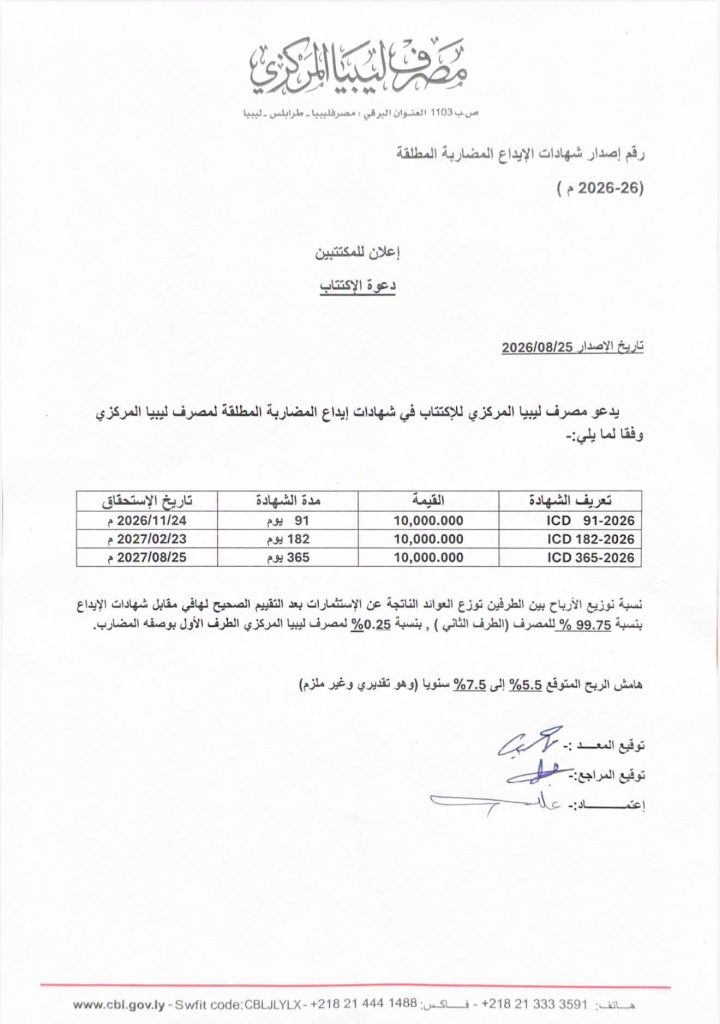
Announcement:

The Central Bank of Libya announces its invitation to commercial banks to subscribe to Issue No. (26–2026) of unrestricted Mudaraba Deposit Certificates, in accordance with the procedures and controls followed in previous issuances, and in line with the tenors and maturity dates specified in the subscription announcement.

Screenshot

The Governor of the Central Bank of Libya Meets with the Special Representative of the UN Secretary-General to Libya to Discuss Economic Developments and Financial Reforms

The Governor of the Central Bank of Libya, H.E. Naji Issa, met on Sunday, August 16, 2026, at his office with the Special Representative of the UN Secretary-General to Libya, Ms. Hanna Tetteh. During the meeting, they discussed the latest economic and financial developments in Libya, as well as the Central Bank of Libya’s efforts to implement financial and economic reforms in cooperation with relevant stakeholders.

The President of the High Council of State and members of the Council affirm their rejection of the apology of the Governor of Central Bank of Libya and their support for his continued service

The Governor of the Central Bank of Libya, H.E. Naji Issa, met with the President of the High Council of State, Dr. Mohamed Takala, accompanied by the First Deputy, Mr. Naji Mukhtar, and the Second Deputy, Mr. Omar Boushah, in the presence of the Council’s Rapporteur, Mr. Belkacem Debrez, and the heads of the Council’s standing committees, on Wednesday, August 12, 2026, in Tripoli.

At the beginning of the meeting, the Council members affirmed their rejection of the Governor’s resignation and his continued service. The Governor of the Central Bank of Libya then reviewed the most prominent financial and monetary indicators and challenges, including those related to the management of public resources, spending, liquidity, and the exchange rate, and their impact on economic stability and the living conditions of citizens.

The importance of the continued smooth operation of the Central Bank of Libya and the preservation of its professional and institutional independence, free from any interference or pressure that could undermine the stability of monetary policy, was emphasized.

The meeting also stressed the need to harmonize fiscal and economic policies, rationalize public spending, close loopholes for waste and corruption, protect public funds and state resources, and enhance transparency and accountability without exception. The participants emphasized the importance of forming a joint technical committee between the State Council and the House of Representatives, in coordination with the Central Bank of Libya and relevant entities. This committee would be tasked with developing a comprehensive package of economic and financial reforms and monitoring their implementation to ensure that existing imbalances are addressed on a scientific and institutional basis.

The attendees stressed that overcoming the economic crisis requires responsible and courageous decisions, support for competent individuals and institutions undertaking their reform duties, and prioritizing the national interest over partisan interests. This will safeguard Libya’s resources, enhance its stability, and bolster confidence in it both domestically and internationally.

The House of Representatives’ Planning and Finance Committee rejects the request for an apology from the Governor of Central Bank of Libya and affirms its support for his continued service

The Planning, Finance, and Public Budget Committee of the House of Representatives held an emergency meeting on Wednesday, August 12, 2026, with H.E. Naji Issa, Governor of the Central Bank of Libya. This meeting was convened following the Governor’s request to resign from his position as a Governer of the Central Bank of Libya.

The Committee rejected his resignation and urged him to continue in his role, offering its support to overcome the difficulties and challenges and to begin working together on a comprehensive economic reform plan aimed at achieving the desired national goals.

Cash Liquidity, Electronic Payments, Foreign Currency Sales, and the Development of Banking Services Highlight Key Areas Discussed at the Meeting Between the Governor and Deputy Governor of the Central Bank of Libya and the General Managers of Major Commercial Banks

The Governor of the Central Bank of Libya (CBL), H.E. Naji Mohammed Issa Belqasem, and the Deputy Governor, Mr. Marei Muftah Al-Baraasi, met today, Wednesday, 5 August 2026, with the General Managers of major commercial banks, including Jumhouria Bank, National Commercial Bank, North Africa Bank, Sahara Bank, and Wahda Bank. The meeting was attended by directors of several relevant departments at the Central Bank and focused on the August plan to provide cash liquidity, strengthen electronic payment services, facilitate the procedures for selling foreign currency allocations for personal purposes, and develop banking infrastructure and improve the quality of banking services provided to citizens.

The meeting reviewed the Central Bank of Libya’s plan to provide cash liquidity and confirmed the readiness of all branches of commercial banks across Libya to begin distributing cash liquidity to citizens as of Sunday morning, with increased withdrawal limits aligned with citizens’ needs.

In this regard, it was agreed to take into account the exceptional circumstances affecting certain areas, particularly in light of recurring power outages and shortages in fuel supplies, which may increase citizens’ need for local cash during this period. Accordingly, the withdrawal limit will be LYD 3,000 through bank branches in the western, eastern, and central regions, comprising LYD 2,000 through branch counters and LYD 1,000 through ATMs.

The withdrawal limit for bank branches in the southern region was set at LYD 4,000, comprising LYD 2,000 through branch counters and LYD 2,000 through ATMs. The Central Bank will continue assessing the needs of different regions and consider the possibility of increasing withdrawal limits in the western, eastern, and central regions in the coming weeks, while continuing to supply banks and their branches with cash liquidity whenever necessary.

As part of monitoring financial inclusion indicators, the meeting reviewed the latest data on the use of electronic payment methods, which showed unprecedented growth in the volume of electronic transactions.

The indicators showed that instant payment services LYPay and OnePay recorded transactions worth LYD 252 billion, while payments made through bank cards at Point-of-Sale (PoS) terminals reached LYD 33 billion, through more than 270,000 PoS terminals operating across Libya. This reflects the rapid expansion in the use of electronic payment methods.

Transactions conducted through mobile banking applications reached LYD 209 billion, while the Real-Time Gross Settlement (RTGS) system recorded transactions worth LYD 143 billion. Transactions through electronic wallets amounted to LYD 650 million, while ATM withdrawals reached LYD 5 billion.

Accordingly, the total value of electronic transactions recorded from January to July 2026 reached approximately LYD 643 billion. This represents an unprecedented achievement, with electronic transactions expected to exceed LYD 1 trillion by the end of the year, an accomplishment not previously recorded in Libya across any economic indicator of this scale.

The Governor and Deputy Governor emphasized that these indicators reflect the success of the Central Bank of Libya’s efforts to promote digital transformation and expand financial inclusion. They stressed the importance of continuing to develop banks’ technological infrastructure, complying with the requirements and instructions set out in the IT Governance Guidelines, and strengthening information security and cybersecurity systems to ensure the continuity of banking services and protect systems and data.

Regarding the sale of foreign currency allocations for personal purposes, participants confirmed that foreign currency sales centers operated by commercial banks continue to provide their services regularly and smoothly, both through cash foreign currency disbursements and the loading of foreign currency onto bank cards, ensuring that citizens receive the service in accordance with the approved regulations and procedures.

At the conclusion of the meeting, it was agreed to continue monitoring the implementation of the Central Bank of Libya’s plan to develop the banking sector, improve the quality of services provided to citizens, and strengthen financial and monetary stability during the second half of the current year.

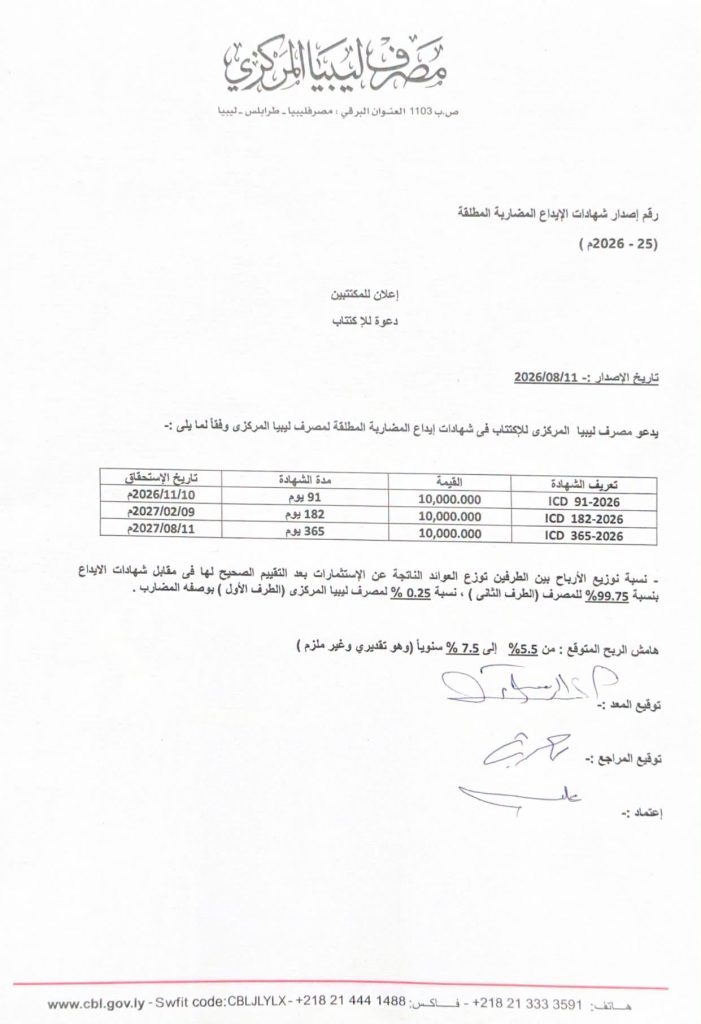
Announcement:

The Central Bank of Libya announces its invitation to commercial banks to subscribe to Issue No. (25–2026) of unrestricted Mudaraba Deposit Certificates, in accordance with the procedures and controls followed in previous issuances, and in line with the tenors and maturity dates specified in the subscription announcement.

Screenshot

The Central Bank of Libya announces the commencement of salary disbursements for July through the “Instant Salary” system.

The Central Bank of Libya confirms receiving the July salary disbursement authorizations from the Ministry of Finance. These authorizations are currently being transferred to commercial banks for immediate processing through the “Your Salary Instantly” system, which allows citizens to track their salary payments transparently.

According to the latest data, the number of public sector employees registered in the project reached approximately 1.7 million by July, compared to 2.2 million previously, representing a 76% participation rate.

The Central Bank continues to encourage sectors that have not yet joined the project to do so, given its ease of access to salaries and its role in protecting public funds.

The “Instant Salary” project is part of the digital transformation efforts aimed at enhancing transparency within the public financial management system and ensuring that salaries reach their recipients on time without delay.

Citizens can check the status of their salaries through the Citizens’ Platform at the following link: http://fcms.cbl.gov.ly

They can also monitor the implementation statistics of commercial banks regarding salary payments through: http://cbl.gov.ly/salary

The Central Bank continues to develop the project by automating the complaints mechanism and resolving issues related to unpaid salaries, in cooperation with the Ministry of Finance.

The Central Bank of Libya reaffirms its commitment to developing digital banking services and improving the efficiency of disbursement procedures, in line with the requirements of the digital transformation of the financial sector.

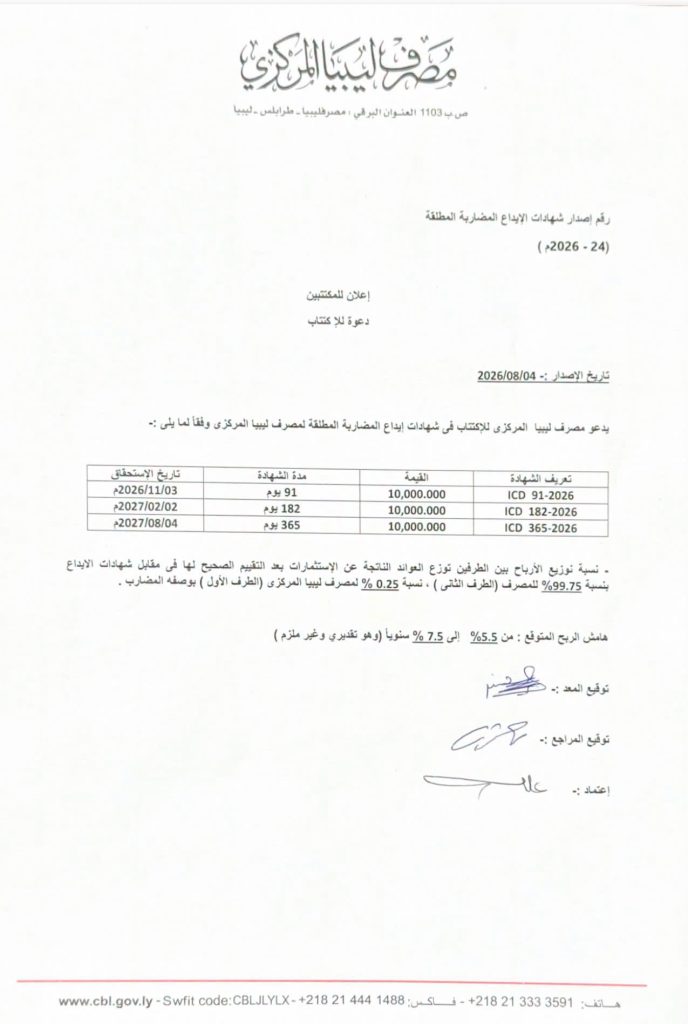
Announcement:

The Central Bank of Libya announces its invitation to commercial banks to subscribe to Issue No. (24–2026) of unrestricted Mudaraba Deposit Certificates, in accordance with the procedures and controls followed in previous issuances, and in line with the tenors and maturity dates specified in the subscription announcement.

Screenshot

Governor of the Central Bank of Libya Holds High-Level Meeting to Review Exchange Rate Stability Strengthen Foreign Currency Availability and Enhance Cash Liquidity for Commercial Banks

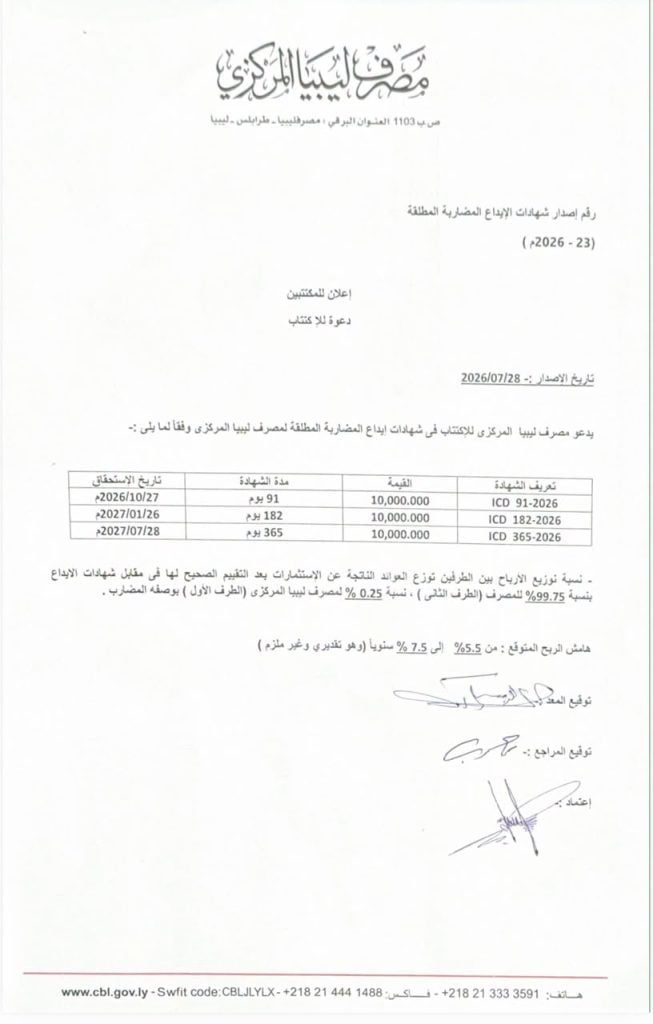
Announcement:

The Central Bank of Libya announces its invitation to commercial banks to subscribe to Issue No. (23–2026) of unrestricted Mudaraba Deposit Certificates, in accordance with the procedures and controls followed in previous issuances, and in line with the tenors and maturity dates specified in the subscription announcement.

Central Bank of Libya and People’s Bank of China Strengthen Strategic Partnership in Payments and Investment

The Governor of the People’s Bank of China, H.E. Pan Gongsheng, received the Governor of the Central Bank of Libya, H.E. Naji Mohammed Issa Belqasem, and the accompanying delegation in Beijing, as part of ongoing efforts to strengthen financial and banking cooperation between the State of Libya and the People’s Republic of China and to further consolidate the strategic economic partnership between the two countries.

The meeting featured extensive discussions on prospects for expanding bilateral cooperation across the banking and financial sectors, as well as enhancing the institutional partnership between the two central banks in support of financial sector development and its capacity to respond effectively to the rapidly evolving global economic landscape.

As part of efforts to strengthen cooperation in cross-border payment and settlement systems, the two sides officially agreed to facilitate the participation of Libyan banks in the Cross-Border Interbank Payment System (CIPS). This strategic milestone is expected to streamline trade and financial transactions, facilitate cross-border payments and transfers between Libya and China, improve the efficiency of financial transactions, enhance trade flows, and better serve the business communities of both countries.

The two sides also reached an agreement on diversifying Libya’s investment portfolio through entry into the Chinese bond market, in line with the Central Bank of Libya’s strategy to diversify its reserve investment portfolio and strengthen reserve management. H.E. the Governor of the People’s Bank of China welcomed this initiative, reaffirming China’s support for the Central Bank of Libya’s strategic direction and encouraging broader investment cooperation to further promote trade and investment between the two countries.

The meeting also explored opportunities to benefit from China’s leading experience in developing financial sector infrastructure, digital payment systems, and modern financial technologies. These areas of cooperation are expected to support the Central Bank of Libya’s efforts to modernize banking services, improve operational efficiency, and align its financial infrastructure with international standards and global best practices.

Both Governors underscored the importance of maintaining close coordination, exchanging expertise, and further strengthening institutional cooperation between the two central banks. They reaffirmed their shared commitment to expanding financial and economic cooperation and building a deeper, more sustainable strategic partnership that reflects the strength of bilateral relations and the mutual aspirations of both countries for sustainable development and shared prosperity.

At the conclusion of the meeting, the two sides agreed to launch the Libyan–Chinese Banking Forum for the first time. The inaugural forum will be held on the sidelines of the Forum on China–Africa Cooperation (FOCAC) in early 2027, serving as an institutional platform that brings together banks and financial institutions from both countries to promote investment partnerships and expand cooperation opportunities across the banking and financial sectors.