Abdulfatah - Page 6 of 16

Author: Abdulfatah

The Central Bank of Libya announces the commencement of salary disbursements for April through the “Instant Salary” system.

The Central Bank of Libya confirms that it has just received salary payment orders for April from the Ministry of Finance and has immediately transferred them to commercial banks for prompt execution through the “Ratabk Lahthi” (Instant Salary) system, which enables citizens to track their salary disbursement process with full transparency.

According to the latest data, the number of public sector employees registered under the project has reached approximately 1.7 million out of a total of 2.2 million employees as of April, achieving a participation rate of 75%.

The Central Bank continues to call on public entities that have not yet joined the project to do so, given its role in facilitating employees’ access to their entitlements and strengthening public fund protection.

The “Ratabk Lahthi” initiative forms part of broader efforts toward digital transformation and enhanced transparency within public financial management systems, ensuring timely and efficient salary payments to beneficiaries.

Citizens can check the status of their salaries via the official citizen portal:
http://fcms.cbl.gov.ly

They can also monitor the implementation statistics of commercial banks regarding salary payments through: http://cbl.gov.ly/salary

Furthermore, the Central Bank plans to further develop the project by automating the complaint-handling mechanism and resolving unpaid salary issues in coordination with the Ministry of Finance.

The Central Bank of Libya reaffirms its commitment to advancing digital banking services and improving payment efficiency in line with the requirements of the financial sector’s digital transformation.

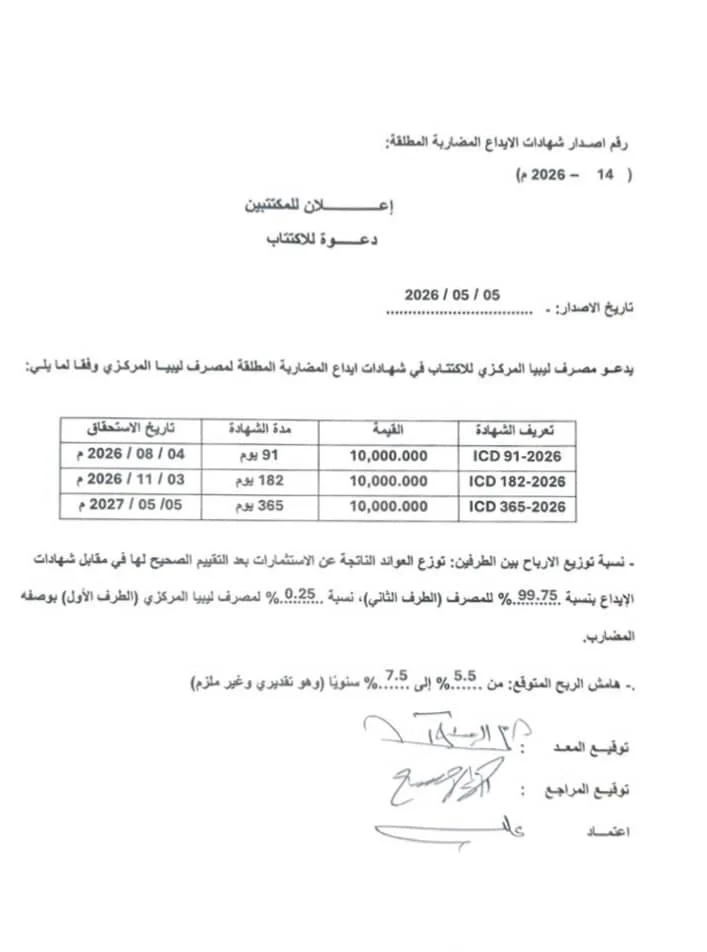
Announcement:

The Central Bank of Libya announces its invitation to commercial banks to subscribe to Issue No. (14–2026) of unrestricted Mudaraba Deposit Certificates, in accordance with the procedures and controls followed in previous issuances, and in line with the tenors and maturity dates specified in the subscription announcement

Governor of the Central Bank of Libya Meets with the Deputy Special Representative of the UN Secretary-General and UN Resident Coordinator in Libya

A meeting was held on Tuesday, 28 April 2026, between H.E. Mr. Naji Issa, Governor of the Central Bank of Libya, and Ms. Ulrika Richardson, Deputy Special Representative of the United Nations Secretary-General and United Nations Resident Coordinator in Libya, in the presence of the UN economic team, as well as directors of the relevant departments at the Central Bank.

This meeting came within the framework of the United Nations mission’s commitment to support the package of economic reforms led by the Central Bank of Libya, with the aim of achieving economic stability.

The meeting discussed several key areas, most notably:

  • Developments in the foreign exchange market and possible measures to achieve financial sustainability.
  • The readiness of Libyan institutions to implement the recommendations of the Structured Dialogue, particularly in the economic track sponsored by the UN mission.
  • Updates on the financial situation following the signing of the unified public expenditure agreement, and the requirements for maintaining macroeconomic stability.
  • Identification of priority areas and the development of a sequenced reform roadmap to support the gradual and effective implementation of reforms.

At the conclusion of the meeting, Ms. Ulrika Richardson and the accompanying UN delegation commended the efforts of the Central Bank of Libya in advancing genuine and comprehensive economic reform.

Governor of the Central Bank of Libya Discusses Strengthening Banking Cooperation and Strategic Partnership with the Chinese Ambassador to Libya

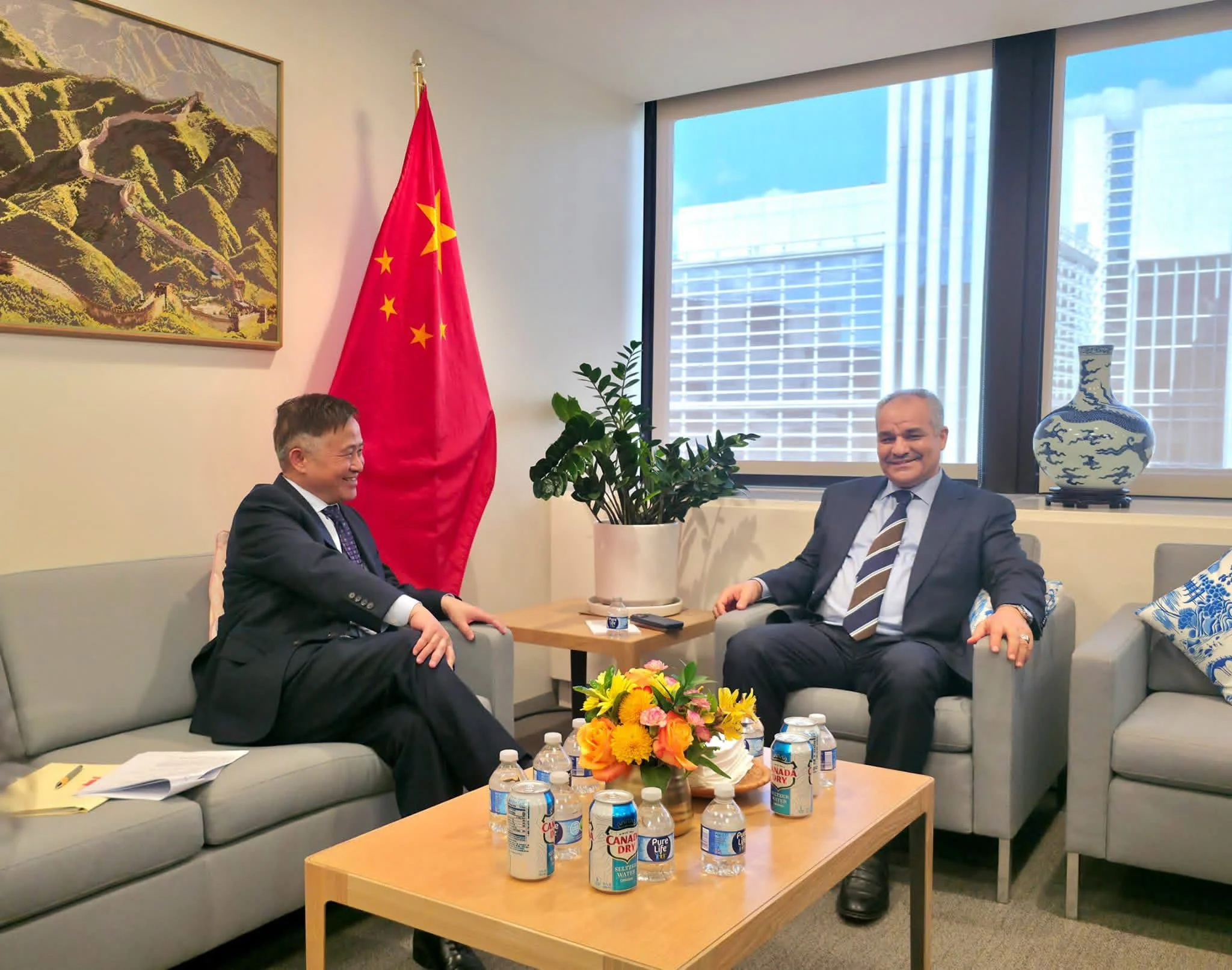
H.E. Mr. Naji Issa, Governor of the Central Bank of Libya, held a meeting on Monday morning, April 27, 2026, with Mr. Ma Xuliang, Ambassador of the People’s Republic of China to Libya, in the presence of Mr. Liu Jian, Counselor and Chargé d’Affaires at the Embassy.

This meeting comes as a follow-up to the outcomes of the Governor’s recent meeting with his counterpart, the Governor of the People’s Bank of China, held on April 18 on the sidelines of the Annual Meetings of the International Monetary Fund and the World Bank.

The discussions addressed the volume of trade exchange between the two countries, in addition to reviewing the key features of the roadmap for the new phase of the strategic partnership agreed upon between the Libyan and Chinese banking sectors.

The meeting also touched on the commencement of logistical arrangements for an upcoming visit by a Libyan banking delegation, headed by the Governor and including general managers of Libyan commercial banks, to the People’s Republic of China. The visit aims to establish bilateral cooperation between commercial banks in both countries and to benefit from China’s expertise in electronic payments and direct financial transfers.

Governor of the Central Bank of Libya Receives the Chargé d’Affaires of the United States Embassy to Libya

On Monday morning, April 27, 2026, H.E. Mr. Naji Issa, Governor of the Central Bank of Libya, received at his office Mr. Jeremy Brent, Chargé d’Affaires of the United States Embassy to Libya, and Ms. Inga Heemink, Deputy Chief of Mission at the Embassy.

The meeting reviewed recent financial and economic developments, as well as the ongoing efforts to implement the unified public expenditure framework, in addition to the reforms undertaken by the Central Bank to achieve financial and economic stability. The two sides also discussed ways to coordinate efforts with Libyan institutions to advance further reforms and measures at the national economic level, and to support the National Oil Corporation’s efforts to increase production and secure the necessary financial resources.

Governor of the Central Bank of Libya Sets Date with Commercial Banks for Commencing Cash U.S. Dollar Sales

H.E. Mr. Naji Issa, Governor of the Central Bank of Libya, held an expanded meeting on the morning of Sunday, April 26, 2026, with the General Managers of major commercial banks, in the presence of directors of relevant departments at the Central Bank. The meeting was convened as part of his efforts to address all obstacles facing citizens in accessing foreign currency in cash with ease and efficiency.

During the meeting, the mechanism for selling U.S. dollars in cash was reviewed, with an allocation of one billion dollars to be disbursed in two tranches. Emphasis was placed on the readiness of commercial banks to fully comply with the Central Bank of Libya’s instructions. The participants also discussed ways to enhance the electronic booking system, agreeing to further simplify booking procedures to ensure ease of use for all citizens and to increase uptake of personal foreign currency allocations.

In line with ensuring the secure distribution of currency, the meeting stressed the importance of tightening the security plan for receiving and distributing cash dollar shipments to the head offices of banks and their approved branches serving as distribution points across Libya.

The meeting concluded with agreement on the following:

  1. Immediate commencement of disbursement for bookings: Starting Monday, April 27, 2026, banks will begin receiving individuals’ allocations from the Issuance Department at the Central Bank of Libya, based on the sequential booking priority in the foreign currency booking system.
  2. Strengthened first tranche: An amount of one billion dollars has been allocated as a first tranche to commercial banks, of which 500 million dollars will be delivered tomorrow, with continued supply of additional shipments based on actual demand recorded in the system.
  3. Start date for cash dollar disbursement to citizens: The distribution of cash dollars to individuals will begin at the start of next week, Sunday, May 3, 2026, allowing banks sufficient time to complete all logistical and technical arrangements and to reach booking levels aligned with the targeted allocation by next Wednesday.

The Central Bank of Libya reaffirms its commitment to providing foreign currency for all purposes in accordance with the highest standards of security and transparency, and commends the cooperation of commercial banks in ensuring the success of this plan, which falls within the Bank’s policies to maintain currency stability and meet citizens’ needs.

Announcement:

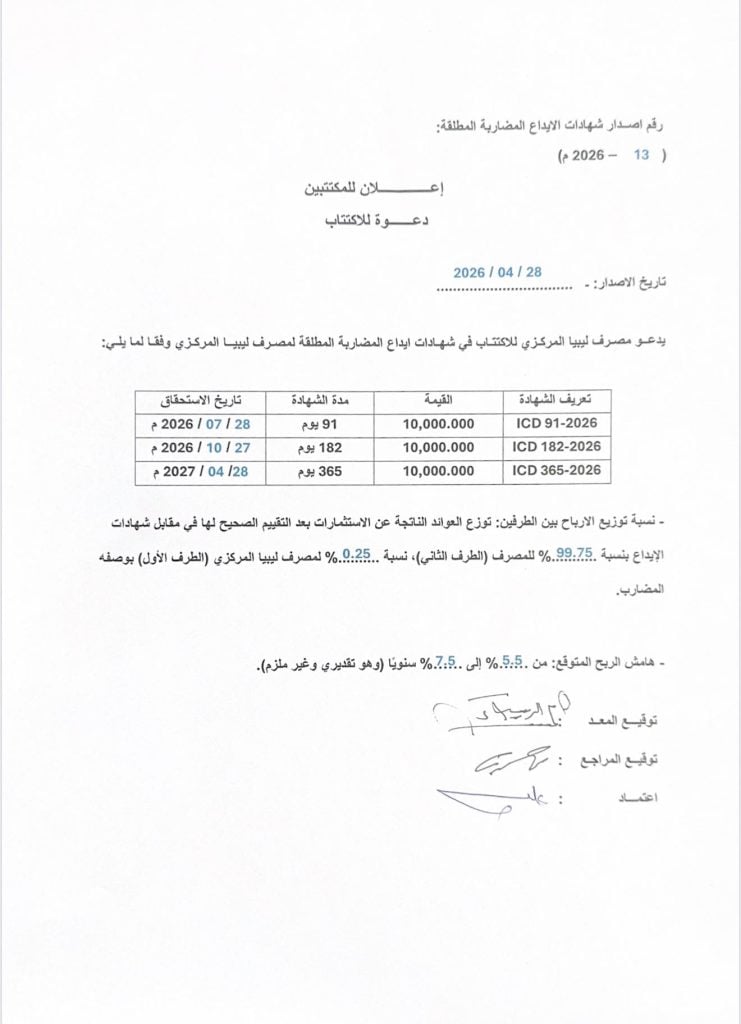
The Central Bank of Libya announces its invitation to commercial banks to subscribe to Issue No. (13–2026) of unrestricted Mudaraba Deposit Certificates, in accordance with the procedures and controls followed in previous issuances, and in line with the tenors and maturity dates specified in the subscription announcement

Governor of the Central Bank of Libya Agrees with the Governor of the People’s Bank of China to Launch Direct Banking Transactions

H.E. Mr. Naji Mohammed Issa, Governor of the Central Bank of Libya, met on Friday, April 17, 2026, with Mr. Pan Gongsheng, Governor of the People’s Bank of China. The meeting reviewed the volume of bilateral trade between the two countries and discussed ways to enhance it and increase its growth rate.

The two sides also emphasized the importance of launching a new phase of a genuine strategic partnership between the two central banks. In this regard, they agreed to connect Libyan commercial banks to China’s Cross-Border Interbank Payment System (CIPS), which would facilitate financial transfers in a more efficient and streamlined manner.

Furthermore, both parties agreed to address existing challenges and work towards facilitating bilateral trade procedures to boost trade volumes. This includes initiating direct remittance transfers to China to support small traders, as well as enabling the opening of letters of credit directly through Chinese banks.

The two sides also agreed to organize an official visit of a Libyan banking delegation, headed by the Governor and accompanied by the general managers of Libyan commercial banks, to China in the near future. The visit aims to meet with the People’s Bank of China and Chinese commercial banks to strengthen bilateral cooperation and benefit from China’s experience in electronic payments and direct financial transfers. This is expected to help reduce reliance on the parallel market, ensure compliance with anti-money laundering and counter-terrorism financing standards, and enhance the reputation of the Libyan banking sector.

Governor of the Central Bank of Libya Reviews Currency Printing Plan with De La Rue in Washington

On the sidelines of the Spring Meetings of the International Monetary Fund and the World Bank Group held in Washington, D.C., H.E. Mr. Naji Mohammed Issa, Governor of the Central Bank of Libya, and his accompanying delegation met on Friday, April 17, 2026, with Mr. Clive Vacher, Chief Executive Officer of De La Rue, in the presence of Mr. Damian Kwiatowski, Executive Vice President for International Sales to Central Banks.

The meeting focused on the Governor’s follow-up on the implementation of the Central Bank of Libya’s currency printing plan, particularly for the new denominations (5, 10, and 20 Libyan dinars). Discussions also covered the delivery schedule of shipments as agreed between both parties, with the aim of ensuring a smooth and timely supply of domestic liquidity to meet citizens’ needs and guarantee adequate availability ahead of Eid al-Adha.

At the conclusion of the meeting, De La Rue presented the Governor with an award from the High Security Printing EMEA forum, recognizing the twenty-dinar banknote, which won the “Best Banknote Design in the World 2025” award in terms of design, print quality, and security features.

Participation of the Governor of the Central Bank of Libya in the closed meeting of the International Monetary and Financial Committee (IMFC) in Washington

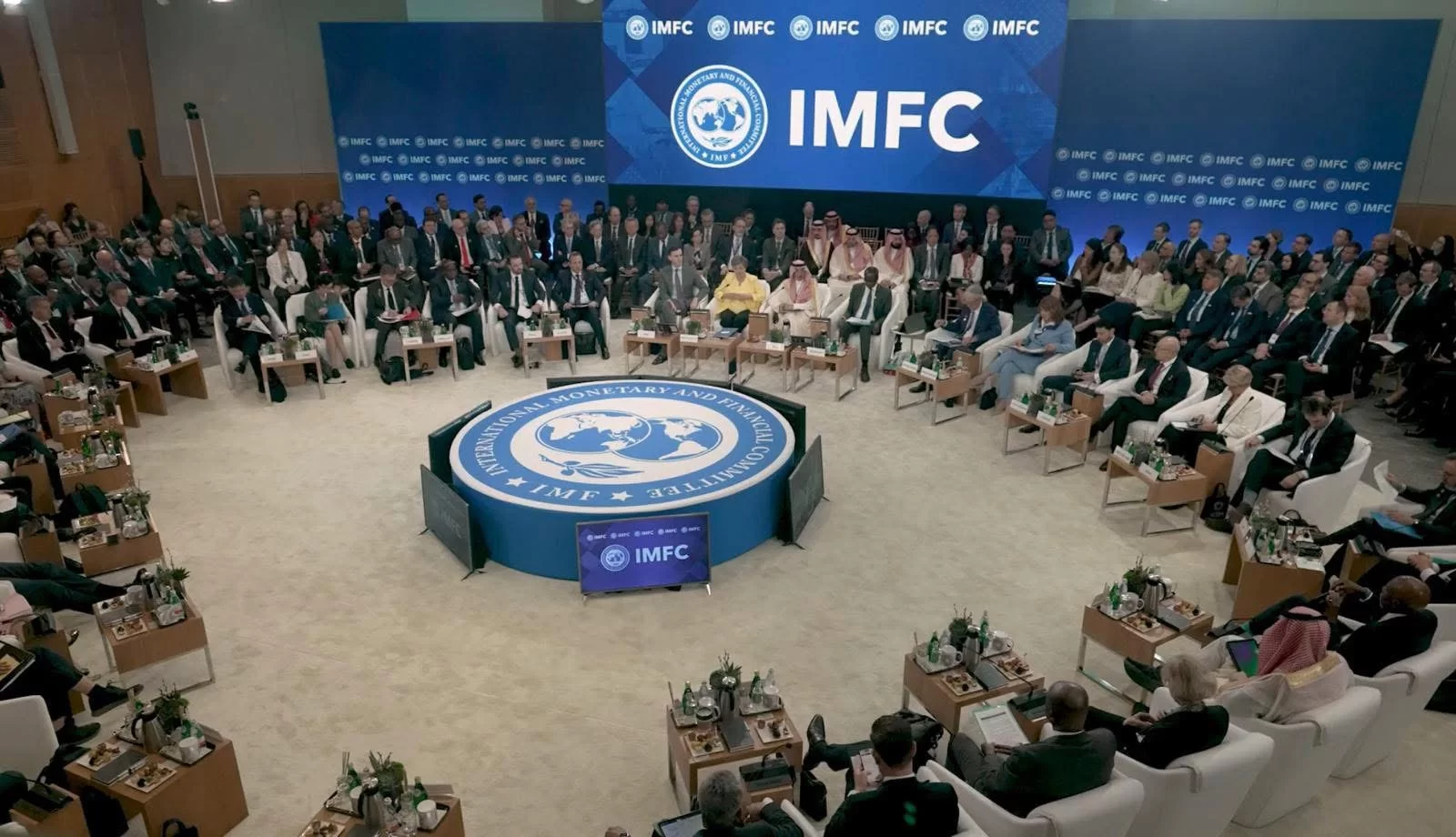
H.E. Mr. Naji Mohammed Issa, Governor of the Central Bank of Libya, participated on Friday, April 17, 2026, in the closed meeting of the International Monetary and Financial Committee (IMFC), held at the headquarters of the International Monetary Fund in Washington, D.C., on the sidelines of the 2026 Spring Meetings.

The meeting addressed the most prominent recent developments and challenges facing the global economy, and reviewed the outlook for economic growth in both the short and medium term. It also addressed ways to enhance the stability of the global financial system and to support multilateral cooperation efforts in tackling geopolitical and structural risks affecting financial markets.

This participation comes within the framework of the Central Bank of Libya’s ongoing efforts to closely monitor international economic and financial developments and its commitment to exchanging views with international financial institutions and policymakers, in a manner that supports the Bank’s policies and enhances Libya’s standing in global financial forums.

Announcement:

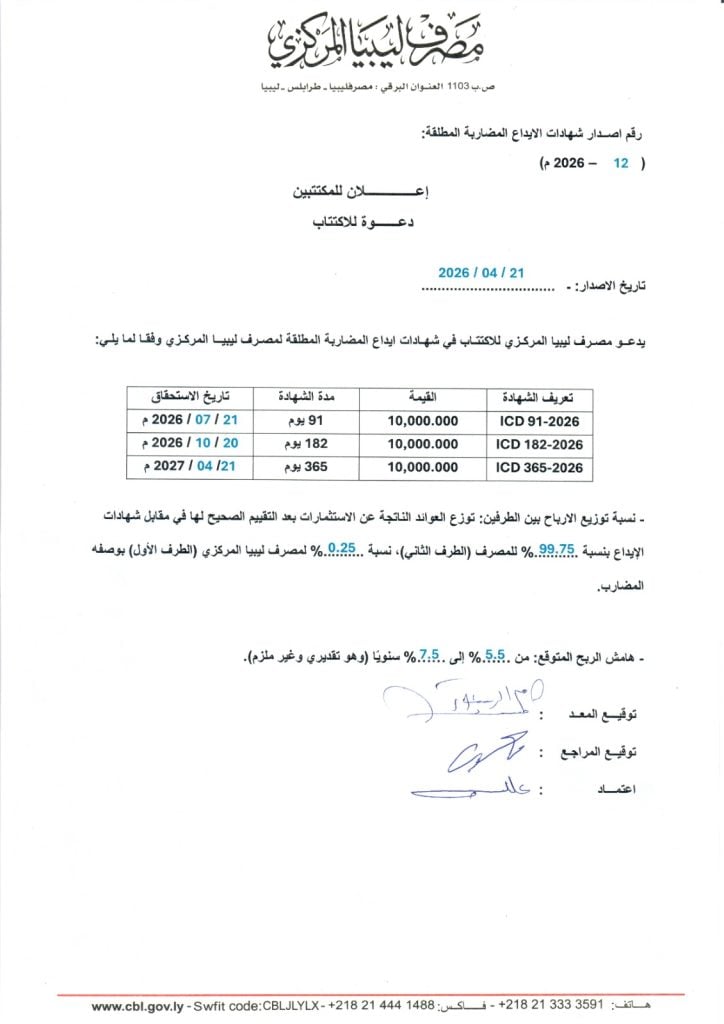
The Central Bank of Libya announces its invitation to commercial banks to subscribe to Issue No. (12–2026) of unrestricted Mudaraba Deposit Certificates, in accordance with the procedures and controls followed in previous issuances, and in line with the tenors and maturity dates specified in the subscription announcement

Governor of the Central Bank of Libya Announces Adoption of the First Unified Budget in More Than 13 Years

The Governor of the Central Bank of Libya, H.E. Mr. Naji Mohammed Issa, announced on Saturday, April 11, 2026, the adoption of the first unified budget in more than thirteen years. He emphasized that this agreement between the House of Representatives and the High Council of State represents a pivotal step toward ending financial division and strengthening economic stability in the country.

The Governor explained that this initiative will contribute to stabilizing the exchange rate and strengthening the Libyan dinar by rationalizing public spending and reducing fiscal imbalances. He also noted that the approval of expenditure tables within the framework of the unified development agreement reflects progress in unifying fiscal policies and enhancing financial discipline, in a manner that supports sustainability and promotes balanced development across Libya.