
IMF: Staff Concluding Statement of the Libyan 2026 Article IV Mission
IMF mission’s concluding statement has been published on the IMF’s official website.
Please click on the link to access the concluding statement:
IMF mission’s concluding statement has been published on the IMF’s official website.
Please click on the link to access the concluding statement:

Reorienting fiscal policy to serve as a complement to the monetary policy pursued by the Central Bank of Libya, with the aim of achieving economic stability.
The Governor of the Central Bank of Libya, Mr. Naji Mohammed Issa, met with the Minister of Finance of the Government of National Unity, Mr. Rashid Abu Ghuffa, on Thursday, April 9, 2026, at the Ministry of Finance headquarters.
During the meeting, a number of issues related to the economic landscape were discussed in light of the current international and domestic conditions. In this regard, both sides emphasized the following:
Supporting the Central Bank of Libya’s policies aimed at preserving the national currency and maintaining exchange rate stability.
Emphasizing the importance of ensuring the regular and smooth transfer of oil revenues, improving tax administration for both the Tax and Customs Authorities, and enhancing electronic collection systems across all main and sub-treasuries of the Ministry of Finance.
The need to intensify efforts to complete the “Instant Salary” system project and improve progress rates in the coming months, which had reached 72% as of March.

The first regular meeting of the National Committee for Combating Money Laundering and Terrorism Financing (ِAML/CFT) for 2026 was held this Thursday morning, April 9, 2026, at the headquarters of the Central Bank of Libya. The meeting was chaired by Mr. Naji Mohammed Issa, Governor of the Central Bank of Libya and Chairman of the Committee, with the participation of representatives from relevant governmental, judicial, security, and supervisory authorities.
The meeting reviewed the latest developments in the implementation of the National Strategy for Combating Money Laundering and Terrorism Financing, as well as the outcomes of the first meeting of the High Committee for the National Risk Assessment.
The session also addressed the measures undertaken in preparation for the upcoming mutual evaluation to which the country will be subject. In addition, discussions highlighted the risks arising from the continued non-adoption of the draft law on combating money laundering and terrorism financing. This situation implies the absence of a legislative framework aligned with relevant international standards and recommendations, and the potentially serious consequences this may have on the country’s financial and economic system.
Furthermore, the Committee discussed several initiatives aimed at strengthening preventive controls and safeguarding the financial system, in line with the reform policies pursued by the Central Bank of Libya and the National Committee. In this regard, a number of decisions were adopted.

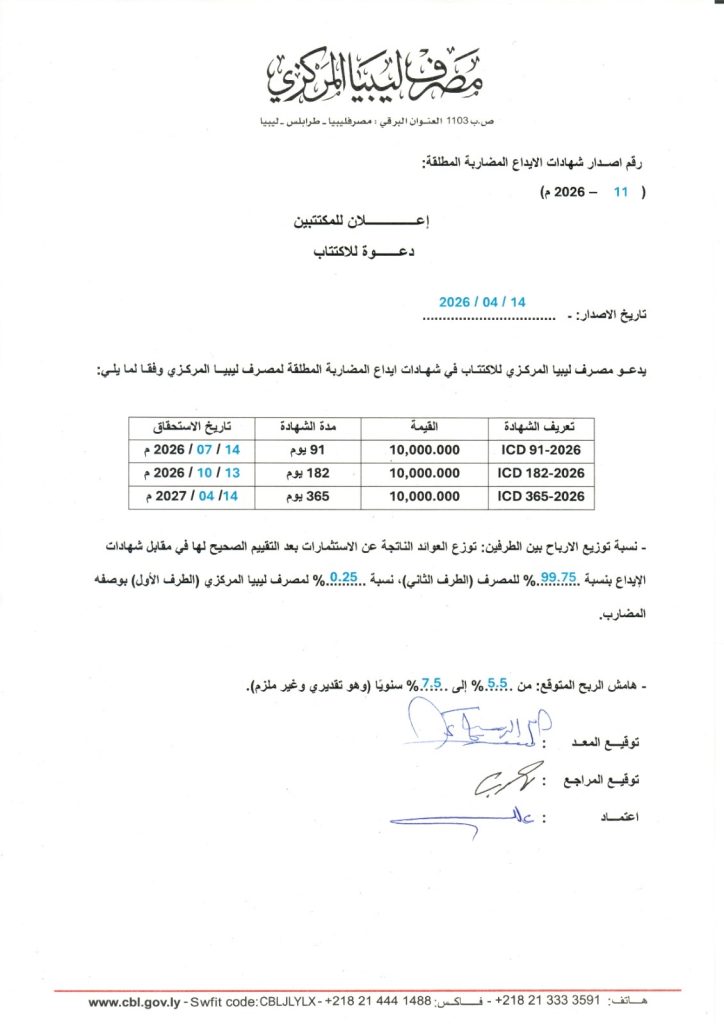
The Central Bank of Libya announces its invitation to commercial banks to subscribe to Issue No. (11–2026) of unrestricted Mudaraba Deposit Certificates, in accordance with the procedures and controls followed in previous issuances, and in line with the tenors and maturity dates specified in the subscription announcement

The Central Bank of Libya announces that it has received the salary disbursement authorizations for the month of March from the Ministry of Finance. These have been transferred to commercial banks to initiate processing through the “Your Salary Instantly” system, which enables citizens to track the status of their salary payments in a direct and transparent manner.
The number of public sector employees enrolled in the “Your Salary Instantly” project reached 1.585 million as of March, out of a total of 2.2 million employees at the start of the project, representing a participation rate of 72%.
The Central Bank urges the remaining sectors that have not yet joined the project to do so, given its importance in facilitating employees’ access to their entitlements and safeguarding public funds.
The Bank also affirms that the “Your Salary Instantly” project is part of its broader efforts toward digital transformation and enhancing transparency in public financial management, ensuring that salaries are delivered to beneficiaries in a timely manner without delay.
Citizens can track the status of their salary payments through the Citizens’ Platform at the following link: fcms.cbl.gov.ly
They can also view statistics on salary disbursements by commercial banks via: cbl.gov.ly/salary
Furthermore, the Central Bank is currently working on further developing the project by automating the complaints handling mechanism and resolving pending salary payments in coordination with the Ministry of Finance.
The Central Bank of Libya reaffirms its commitment to advancing digital banking services and improving the efficiency of disbursement procedures in line with the requirements of digital transformation in the financial sector.
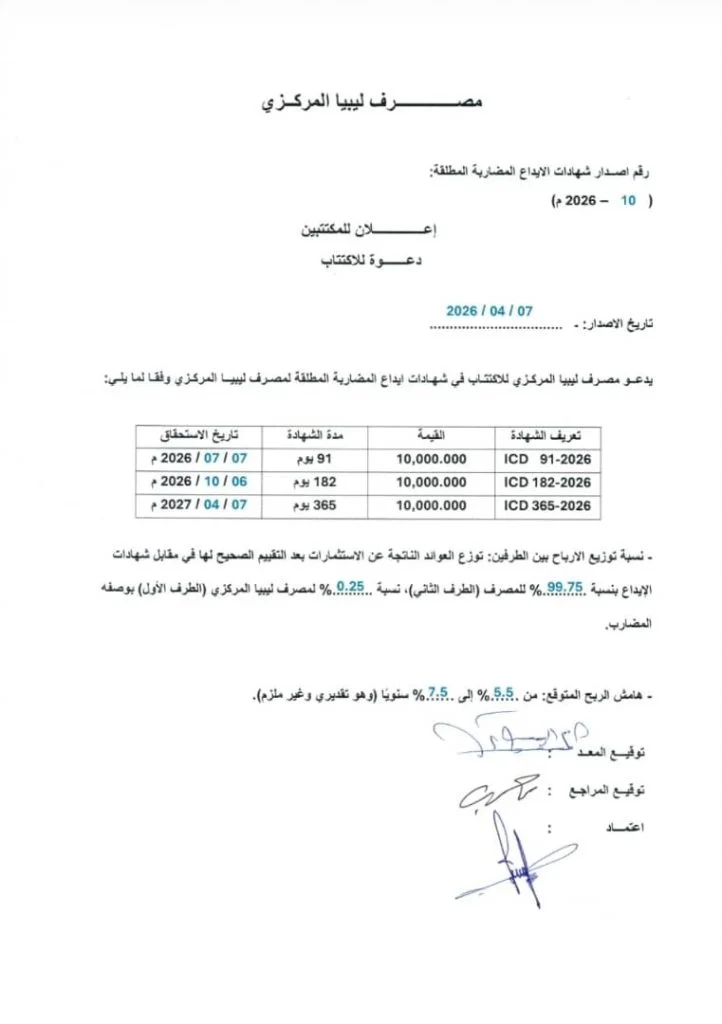
The Central Bank of Libya announces its invitation to commercial banks to subscribe to Issue No. (10–2026) of unrestricted Mudaraba Deposit Certificates, in accordance with the procedures and controls followed in previous issuances, and in line with the tenors and maturity dates specified in the subscription announcement.

As As part of ongoing efforts to monitor the implementation of digital transformation plans and to promote the expansion of electronic payment services, Mr. Naji Mohammed Issa, Governor of the Central Bank of Libya, held an expanded meeting at his office on Tuesday, March 31, 2026. The meeting was attended by a number of general managers of commercial banks, directors of relevant departments at the Central Bank, and the General Manager of Moamalat Financial Services Company.
During the meeting, several measures aimed at ensuring financial market stability and advancing the banking sector were discussed. Key focus areas included:
At the end of the meeting, the Governor emphasized the importance of facilitating access for citizens and businesses to electronic banking services and maintaining close coordination between the Central Bank and commercial banks to implement these measures and address challenges facing the banking sector, thereby contributing to monetary stability and strengthening confidence in the Libyan banking system.
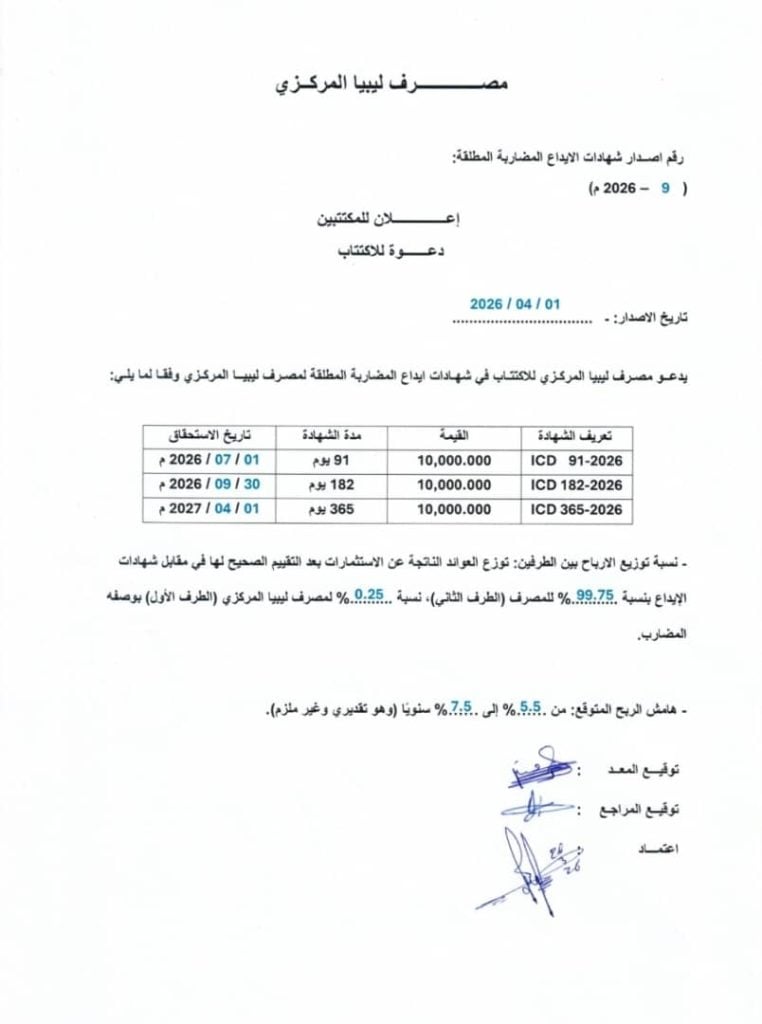
The Central Bank of Libya announces its invitation to commercial banks to subscribe to Issue No. (9–2026) of unrestricted Mudaraba Deposit Certificates, in accordance with the procedures and controls followed in previous issuances, and in line with the tenors and maturity dates specified in the subscription announcement.

Governor of the Central Bank of Libya, Mr. Naji Mohammed Issa, held an expanded meeting on Sunday morning, 15 March 2026, with the directors of the relevant departments at the Central Bank. The meeting was dedicated to discussing a package of vital economic and financial issues that directly affect citizens’ daily lives.
During the meeting, participants reviewed the correspondence received from the Chair of the House of Representatives regarding the cancellation of the tax imposed on certain goods, as well as the mechanisms for implementing this decision in coordination with commercial banks. The discussion covered the application of the measure to all goods and purposes, including personal needs, medical treatment, and study-related expenses.
The attendees also reviewed the Central Bank’s plans and preparations to provide foreign currency in line with the available monthly revenues, at the officially approved exchange rate, to meet all legitimate purposes and needs. In this regard, the Governor directed the concerned departments to expedite the completion of the necessary procedures and technical adjustments to the relevant systems, and to begin implementing the instructions contained in the correspondence of the Speaker of the House of Representatives regarding the resumption of foreign currency sales for all purposes.
As part of the Bank’s commitment to ensuring the stability of daily financial transactions, the meeting also addressed the latest developments concerning the availability of cash liquidity for citizens. Efforts will continue to ensure the smooth circulation of cash and to meet the needs of citizens across all cities and regions of Libya (east, west, and south) within a comprehensive plan aimed at achieving fair and stable liquidity distribution across all banks and their branches.

The Central Bank of Libya (CBL) published today, March 10th, 2026, the Revenue and Expenditure Statement.
The statement covers the period from 1st January to 28th February 2026 and provides details of all sectors.
For more details, please visit our official website: Click here
In the case of any questions, please don’t hesitate to contact our communication unit at: [email protected]

The Governor of the Central Bank of Libya, Mr. Naji Mohammed Issa, held a meeting on Tuesday, 10 March 2026, with Eng. Ali Khamis Al-Farjani, Chairman of the Board of the Libyan Post, Telecommunications and Information Technology Holding Company, in the presence of the CEOs of the telecommunications companies (Libyana, Almadar, and Libya Telecom and Technology), as well as executives from electronic payment companies and relevant departments at the Central Bank.
The meeting discussed ways to strengthen cooperation between the banking sector and the telecommunications sector in order to advance the digital transformation infrastructure and address the challenges hindering the expansion of electronic payment services in Libya.
Participants agreed to increase the transaction limits for electronic wallets and also approved the formation of a joint working group to follow up on the technical and operational measures required to ensure the continuity and ongoing development of these services in an efficient and sustainable manner.
A significant portion of the meeting was also dedicated to discussing mechanisms for integrating expatriate labor into the formal economy through electronic payment systems. This initiative aims to enhance financial inclusion, reduce the informal economy, and better regulate the labor market in a way that supports the country’s economic stability.

As part of the ongoing coordination among Libya’s sovereign institutions, the Governor of the Central Bank of Libya, Mr. Naji Mohammed Issa, held an expanded meeting on Monday, 9 March 2026, with the Chairman of the National Oil Corporation, Mr. Masoud Suleiman, to discuss ways of strengthening cooperation and supporting the stability of the oil sector.
During the meeting, both sides reviewed mechanisms to address the challenges facing the oil sector and to ensure the availability of the necessary resources to support the National Oil Corporation’s ambitious plans to increase production and reach higher output levels. These efforts aim to enhance national revenues, capitalize on the current strength in global oil prices, and help secure the liquidity required to support the state.
The two parties also underscored the importance of maintaining continuous communication and close coordination between the two institutions to ensure smooth operations and effectively overcome potential challenges, particularly with regard to providing the financial facilities required for the National Oil Corporation’s strategic and development projects.
The meeting reflected a strong consensus on the need to work in a unified and coordinated manner, while ensuring the smooth flow of revenues into the Ministry of Finance’s accounts at the Central Bank. Participants noted that this step would provide a strong boost to the oil sector, send positive signals to international companies interested in investing in the Libyan market, and reaffirm the shared commitment among Libyan institutions to work together toward national economic prosperity.