Abdulfatah

Author: Abdulfatah

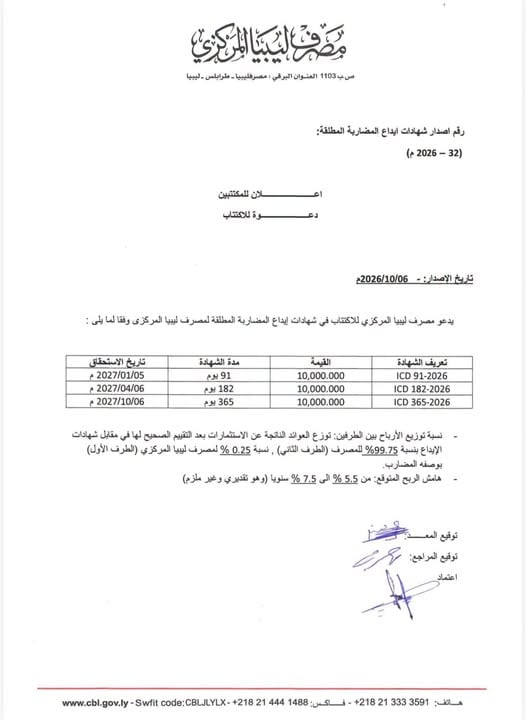
Announcement:

The Central Bank of Libya announces its invitation to commercial banks to subscribe to Issue No. (32–2026) of unrestricted Mudaraba Deposit Certificates, in accordance with the procedures and controls followed in previous issuances, and in line with the tenors and maturity dates specified in the subscription announcement.

Screenshot

Governor of the Central Bank of Libya Participates in the Annual Meeting of the Council of Arab Central Bank Governors and Monetary Authorities

H.E. Naji Mohammed Issa, Governor of the Central Bank of Libya, participated, Tuesday, September 29, 2026, in the 50th session of the Council of Arab Central Bank Governors and Monetary Authorities. Held in Abu Dhabi, UAE, the meeting brought together governors of central banks and monetary authorities from across the Arab world and was organized under the auspices of the Arab Monetary Fund.
The meeting addressed key regional and international economic and financial developments, as well as the challenges facing Arab economies amidst current geopolitical shifts. Discussions also focused on ways to enhance monetary and financial stability, develop the banking sector, support digital transformation and financial inclusion, and improve the efficiency of payment systems and Arab financial markets.
Furthermore, the meeting explored avenues for strengthening cooperation and coordination among Arab central banks and monetary authorities, and for enhancing joint efforts with international financial institutions—foremost among them the International Monetary Fund (IMF) and the World Bank. These efforts aim to bolster the resilience of Arab economies against shocks and foster stability and sustainable growth.
The governors also deliberated on priority issues proposed for inclusion in the 2026 Unified Arab Statement to the IMF and the World Bank. These priorities include increasing financial and technical support for Arab nations, developing local capital markets, supporting digital transformation and sustainable finance, building capacity, and enhancing the representation of Arab countries and professionals within international financial institutions. The proceedings of the Council’s fiftieth session coincide with the fiftieth anniversary of the Arab Monetary Fund’s establishment, reflecting a long-standing journey of Arab monetary and financial cooperation and the Fund’s role in supporting efforts toward economic stability and development in Arab countries.

Central Bank of Libya Governor Participates in Asian Infrastructure Investment Bank (AIIB)Annual Meetings in Doha

H.E. Naji MohamMed Issa, Governor of the Central Bank of Libya, participated on Monday in the 11th Annual Meeting of the Board of Governors of the Asian Infrastructure Investment Bank (AIIB). Held in Doha, Qatar, on September 28–29, the event is themed “Infrastructure for Tomorrow: Impact and Innovation.”
The meeting brings together a distinguished group of finance ministers, central bank governors, representatives from governments and international financial and development institutions, and private sector leaders. They are convening to discuss the future of sustainable infrastructure investment, green finance, digital transformation, regional connectivity, and the mobilization of capital for development projects.
The Governor’s participation aligns with efforts to strengthen Libya’s presence in international financial forums and institutions, expand cooperation with multilateral development organizations, and leverage global expertise in development finance, infrastructure, innovation, and digital transformation.
The meetings also offer an opportunity to hold discussions and exchange views with senior officials and decision-makers from international financial institutions and member states, exploring areas of cooperation that can support development as well as economic and financial stability in Libya.
This year’s meeting holds particular significance as the AIIB enters its second decade of operations, focusing on expanding the impact of its investments and reinforcing its role in financing infrastructure that is more sustainable, resilient, and innovative.

The Central Bank of Libya announces the commencement of September salary payments through the “Your Salary Instantly” system

The Central Bank of Libya confirms receiving the September salary payment authorizations from the Ministry of Finance, and these are currently being transferred to commercial banks for immediate processing via the “Your Salary Instantly” system. This system allows citizens to track their salary payments with complete transparency.

According to the latest data, the number of public sector employees registered in the project reached approximately 1.75 million by September, compared to 2.2 million previously, representing a 79% participation rate.

The Central Bank continues to encourage sectors that have not yet joined the project to do so, highlighting its ease of access to salaries and its role in safeguarding public funds.

The “Your Salary Instantly” project is part of the efforts to digitally transform and enhance transparency within the public financial management system, ensuring that salaries reach their recipients on time without delay.

Citizens can inquire about their salary status through the Citizens’ Platform at the following link: https://fcms.cbl.gov.ly

They can also follow statistics on commercial bank salary disbursements at the following link: https://cbl.gov.ly/salary

The Central Bank continues to develop the project by automating the mechanism for receiving complaints and resolving issues related to undisbursed salaries, in cooperation with the Ministry of Finance.

The Central Bank of Libya reaffirms its commitment to developing digital banking services and improving the efficiency of disbursement procedures in line with the requirements of the digital transformation in the financial sector.

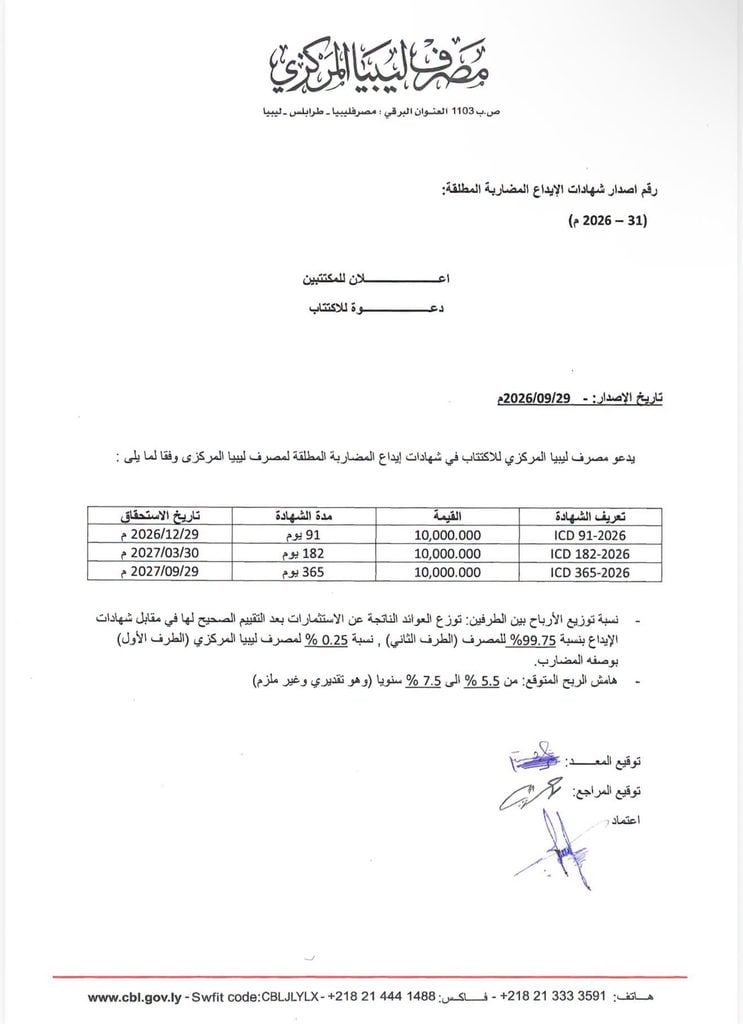
Announcement:

The Central Bank of Libya announces its invitation to commercial banks to subscribe to Issue No. (31–2026) of unrestricted Mudaraba Deposit Certificates, in accordance with the procedures and controls followed in previous issuances, and in line with the tenors and maturity dates specified in the subscription announcement.

Screenshot

Governor of the Central Bank of Libya participates in a meeting of the National Committee for Organizing and Coordinating the Utilization of International Support

Governor of the Central Bank of Libya, H.E. Naji Mohammed Issa, participated on Monday 21st September 2026 in the second meeting of the National Committee for Regulating and Coordinating the Utilization of International Support. Established by Prime Minister’s Decision No. 422/2026 and chaired by the Minister of State for Prime Ministerial and Cabinet Affairs, Dr. Mohamed Omar Bin Ghalbon, the committee is tasked with formulating the necessary frameworks and guidelines to regulate international cooperation and support programs, ensuring they are aligned with national priorities and needs.
The meeting discussed mechanisms to activate the committee’s operations and enable it to fulfill its assigned tasks. It also addressed the establishment of a clear institutional framework to ensure effective coordination among various national entities and to unify efforts regarding international support programs and projects. These measures aim to enhance the efficiency of utilizing such support, minimize duplication and overlapping mandates, and safeguard the confidentiality and privacy of sensitive sovereign data.
Furthermore, the meeting addressed the creation of an electronic system and a unified national database to inventory, document, and track grants, programs, projects, and forms of international support. This initiative seeks to provide accurate, up-to-date data, elevate transparency and governance standards, and facilitate the monitoring of program implementation and the assessment of their results and impact.
During the meeting, the Governor affirmed the Central Bank of Libya’s support for the committee’s efforts and operations, as well as its readiness to contribute to the success of its mission within the Bank’s mandate. He emphasized the importance of establishing an integrated national coordination mechanism among relevant entities and aligning international support with the state’s actual priorities and its reform and development plans, thereby maximizing the benefit derived from available resources and programs. The meeting takes place within the framework of efforts to manage international cooperation and support more efficiently and transparently, based on institutional foundations, and to enhance coordination between state institutions and international partners, thereby serving national priorities and supporting development efforts as well as economic and financial stability.

Governor of the Central Bank of Libya discusses economic reform with the Minister of Finance and the Head of the Audit Bureau.

Governor of the Central Bank of Libya, H.E. Naji Mohammed Issa, held a meeting on Monday 21st september 2026 with the Minister of Finance, Mr. Rashid Abu-Ghaffa, in the presence of the Head of the Audit Bureau, Mr. Khaled Shakshak. The meeting took place within the framework of enhancing coordination and integration among state institutions and monitoring the implementation of the economic reform package related to monetary, fiscal, and trade policies.
The meeting addressed several priority issues, foremost among them the unified salary scale and the implementation of the “Ratibak Lahzi” (Instant Salary) system. These measures aim to organize the payroll process, enhance transparency, and improve the efficiency of public expenditure management.
Discussions also covered efforts to unify and control public spending and to strengthen coordination among relevant entities, ensuring the optimal use of public resources and supporting fiscal discipline and sustainability.
Furthermore, the meeting addressed the monitoring of oil and non-oil revenues, as well as mechanisms to improve collection efficiency and track revenue flows. These measures are intended to support financial and monetary stability and enhance the state’s capacity to manage its resources efficiently and transparently.
The attendees emphasized the importance of continued coordination between the Central Bank of Libya, the Ministry of Finance, the Audit Bureau, and all other state institutions and relevant stakeholders. They underscored the need for joint action to complete and implement the targeted reforms, thereby helping to control public spending, boost revenues, and foster economic and financial stability.

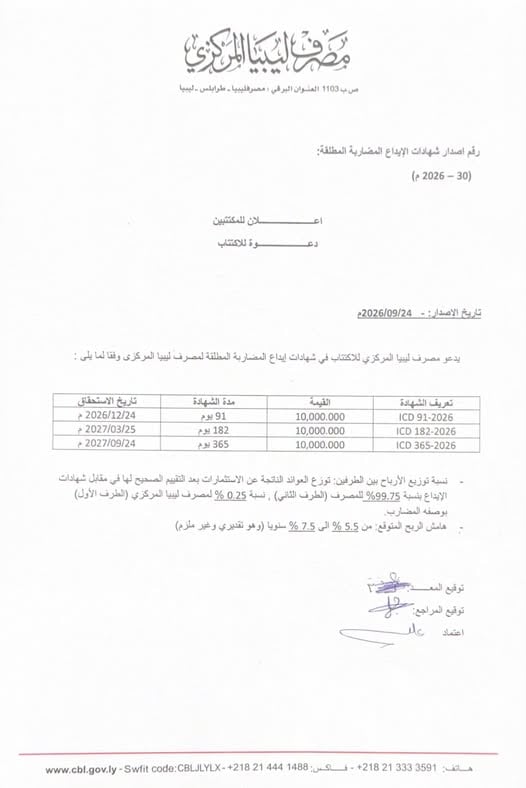
Announcement:

The Central Bank of Libya announces its invitation to commercial banks to subscribe to Issue No. (30–2026) of unrestricted Mudaraba Deposit Certificates, in accordance with the procedures and controls followed in previous issuances, and in line with the tenors and maturity dates specified in the subscription announcement.

Screenshot

Governor of the Central Bank of Libya Holds Meetings with Major International Financial Institutions and Banks in London

As part of efforts to strengthen ties with international financial and banking institutions and expand the horizons of banking and financial cooperation, the Governor of the Central Bank of Libya, H.E. Naji Mohammed Issa, and his accompanying delegation held an extensive meeting in London with representatives from major Arab, regional, and international financial and banking institutions. The meeting was attended by the Arab Bankers Association in London.
Participating institutions included Qatar National Bank (QNB), Arab National Bank, Arab-European Bank, Bank of New York Mellon (BNY), İş Bank (Turkey), Morgan Stanley, Bank ABC (Arab Banking Corporation), British Arab Commercial Bank (BACB), National Bank of Egypt, Bank of Beirut, and Pan Orient Bank.
The discussions covered recent developments in the Libyan banking sector and the Central Bank of Libya’s efforts to implement a comprehensive reform and development program. Key topics included enhancing monetary and financial stability and upgrading the quality and efficiency of banking services to align with internationally recognized standards and practices.
The Governor also highlighted recent achievements in modernizing the banking sector and driving digital transformation. He outlined the rapid evolution of Libya’s payment systems, noting the expanded use of electronic payment methods and instant transfers, the development of payment infrastructure and financial connectivity projects, and the “Ratibak Lahzi” (Instant Salary) initiative, all of which contribute to improving financial service efficiency and fostering financial inclusion.
Furthermore, the meeting addressed the Central Bank of Libya’s initiatives to modernize governance, compliance, and risk management frameworks, enhance the efficiency of commercial banks, and develop banking products and services, thereby strengthening the sector’s ability to keep pace with developments in the global banking and financial industry. Discussions also covered prospects for developing relations between Libyan banks and financial institutions and their international counterparts, as well as strengthening correspondent banking channels and international financial transactions. Furthermore, the exchange of expertise and experience in areas such as risk management, financial stability, compliance, and modern financial technologies was addressed to support the Libyan banking sector’s integration with global financial institutions.
The Governor emphasized the high priority the Central Bank of Libya places on developing relationships with international financial and banking institutions and leveraging global expertise to support the reform and development process. He noted that building a modern, efficient banking sector is a cornerstone for fostering economic and financial stability, improving the business environment, boosting confidence in the financial and banking system, and supporting economic and commercial activity in Libya.

Governor of the Central Bank of Libya meets with the Chief Economic Adviser at the British Foreign Office.

Governor of the Central Bank of Libya, H.E. Naji Mohammed Issa, met on Wednesday, at the UK Foreign Office in London, with the Ministry’s Chief Economic Adviser, Professor Deniz Igan, in the presence of the Director of the Middle East and North Africa Department and his team, and with the participation of the Governor’s accompanying delegation.
The meeting addressed key economic and financial developments in Libya, macroeconomic updates, and current challenges, alongside an exchange of views on various economic and financial issues of mutual interest.
The Governor also outlined the Central Bank of Libya’s efforts to develop the banking sector and enhance its efficiency, promote financial inclusion, ensure monetary and financial stability, and bolster the resilience of the national economy in the face of local and international challenges and variables.
Discussions also covered the Central Bank of Libya’s efforts to unify public spending, enhance anti-money laundering and counter-terrorism financing (AML/CFT) measures, strengthen compliance, governance, and oversight systems within the banking sector, and foster cooperation with relevant national and international bodies. These efforts aim to enhance the integrity and transparency of Libya’s financial and banking system and align it with relevant international standards and practices.
Both sides emphasized the importance of strengthening cooperation and exchanging expertise and insights across economic, financial, and banking sectors, as well as leveraging international experience to support reform and development programs.
This meeting takes place within the framework of the Central Bank of Libya’s efforts to enhance communication channels and cooperation with international partners.

Governor of the Central Bank of Libya Meets Governor of the Bank of England

Governor of the Central Bank of Libya, H.E. Naji Mohammed Issa, met on Wednesday, with the Governor of the Bank of England, Mr. Andrew Bailey, who also serves as Chair of the Financial Stability Board (FSB) and as a member of the Board of Directors of the Bank for International Settlements (BIS), at his office in London. The meeting was held as part of efforts to strengthen cooperation and communication with international financial and banking institutions.

The meeting addressed a number of issues of mutual interest, foremost among them current economic and financial developments, economic reform efforts aimed at maintaining fiscal sustainability, and opportunities to enhance cooperation and exchange expertise in the areas of banking, monetary policy, and financial stability. The discussions also covered the potential to draw on international experiences to support the development and efficiency of the banking sector.

The Governor also highlighted the Central Bank of Libya’s ongoing efforts to implement its financial inclusion initiatives, including the development of electronic payment systems and services, the significant expansion in the use of modern payment methods, and broader access to banking and financial services.

The meeting further addressed the management of foreign reserves and assets, with both sides exchanging views and expertise on international best practices in this area. Discussions included exploring appropriate approaches and options for increasing the Central Bank of Libya’s gold reserves, as part of a balanced reserve management strategy aimed at diversifying its assets and supporting monetary and financial stability.

For his part, the Governor of the Bank of England commended the efforts undertaken by the Central Bank of Libya and the progress and achievements it has made across a number of banking and financial areas, despite the challenges and exceptional circumstances arising from Libya’s political and institutional division, which have made it more difficult for the central bank to carry out its functions and responsibilities under normal conditions. He noted that the progress achieved under these circumstances reflects significant institutional efforts to maintain the Bank’s operations, develop its systems and services, and support monetary and financial stability.

Both sides emphasized the importance of maintaining continued communication, exchanging expertise, and strengthening cooperation between the Central Bank of Libya and the Bank of England, in support of institutional capacity development, the modernization of Libya’s banking sector, and its greater integration into the international financial system.

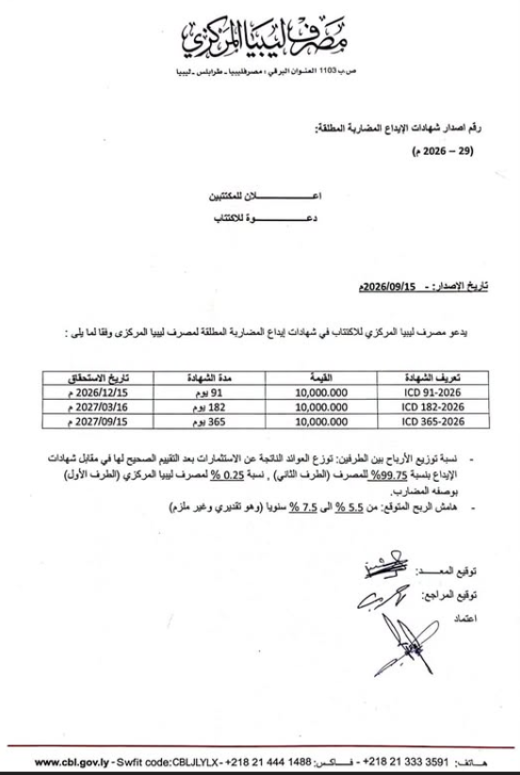
Announcement:

The Central Bank of Libya announces its invitation to commercial banks to subscribe to Issue No. (29–2026) of unrestricted Mudaraba Deposit Certificates, in accordance with the procedures and controls followed in previous issuances, and in line with the tenors and maturity dates specified in the subscription announcement.